What You’ll Learn in This Post
- The official PMBOK definition of project management — and what it means on the ground
- The 5 Process Groups every project moves through — from Initiation to Closing
- The 10 Knowledge Areas a project manager must command
- Why project management is a discipline, not a job title — and why that distinction matters
- The 3 reasons projects fail — and how good PM practice prevents each one
- The difference between managing a project and just doing work
- How Excel fits into professional PM — from day one to program level
In 20+ years of managing projects across IT, retail, construction, banking, and healthcare — I have never once seen a project fail because the team lacked talent. Every failure I have witnessed came down to one thing: the absence of structure. That structure has a name. It is called project management.
If you are new to this field — or you have been doing it informally for years and want to understand the framework behind what you do — this post is your starting point. Not the textbook version. The real version, grounded in two decades of projects that went well, projects that went sideways, and everything I learned from both.
The Official Definition — And What It Actually Means
“Project management is the application of knowledge, skills, tools, and techniques to project activities to meet the project requirements.”
— A Guide to the Project Management Body of Knowledge (PMBOK® Guide), Project Management Institute (PMI)
🧑💼 PNRao’s Plain English VersionProject management is the discipline of getting the right things done, in the right order, by the right people, within agreed boundaries of time, budget, and scope. It is the difference between work that drifts and work that delivers.
That definition sounds simple. In practice, it means holding together a team with competing priorities, managing a sponsor who changes their mind every other week, tracking a budget that never stretches far enough, and still delivering something that works — on a date agreed months ago.
That is what project managers do. Every day. On every project.
🎓 PMP Exam TipThe four elements in the PMBOK definition — knowledge, skills, tools, and techniques — are specifically tested. Know that project management is an application of these four things, not simply the act of planning or scheduling. The PMP exam distinguishes between a PM who uses tools mechanically and one who applies judgment.
Why Project Management Exists — The Problem It Solves
Before frameworks, certifications, or methodologies existed — organisations still had projects. They built cathedrals, dug canals, laid railways. What they didn’t have was a repeatable, transferable system for managing the complexity. So outcomes were wildly inconsistent. The same organisation that built one great thing would fail catastrophically on the next.
Project management exists to make success repeatable — not dependent on one brilliant person having a good year.
Every one of those numbers represents a real organisation that hired smart people, spent real money, and still failed to deliver. Not because of technical incompetence — because the work was not managed as a project. No clear ownership. No defined scope. No structured process. No early warning system.
💡 The Core InsightProject management does not guarantee success. Nothing does. But it dramatically increases the probability of success and — equally important — gives you the early warning signals to course-correct before a problem becomes a crisis.
The 5 Process Groups — How Every Project Moves Forward
PMI organises all project management activity into 5 Process Groups. These are not phases — they are groups of related processes that can happen simultaneously throughout a project’s life.
📌 Important NuanceMonitoring & Controlling runs parallel to all other process groups — not just at the end. You are tracking, measuring, and adjusting throughout the entire project. This is one of the most misunderstood aspects of PMBOK for beginners.
🎓 PMP Exam TipThese 5 Process Groups are not phases and they can overlap. On a large project, you may be Executing Phase 2 while still Planning Phase 3. Know the inputs, tools, techniques, and outputs (ITTOs) of key processes within each group.
The 10 Knowledge Areas — What a PM Must Know
Beyond the 5 process groups, the PMBOK identifies 10 Knowledge Areas — the domains a project manager must be competent in to deliver successfully. Think of these as the subjects on a PM’s curriculum.
| # | Knowledge Area | What It Covers | Why It Matters |
|---|---|---|---|
| 1 | Integration Management | Coordinating all aspects of the project as a unified whole | Stops the left hand not knowing what the right is doing |
| 2 | Scope Management | Defining and controlling what is — and is not — in the project | Prevents scope creep from destroying timelines and budgets |
| 3 | Schedule Management | Planning, sequencing, and controlling the project timeline | Keeps the team working in the right order at the right pace |
| 4 | Cost Management | Estimating, budgeting, and controlling project expenditure | Ensures money is spent intentionally, not accidentally |
| 5 | Quality Management | Ensuring deliverables meet defined requirements and standards | Delivers something worth having, not just something finished |
| 6 | Resource Management | Acquiring, developing, and managing the project team | Gets the right people doing the right work at the right time |
| 7 | Communications Management | Planning and controlling information flow to all stakeholders | No one is surprised, confused, or uninformed at a critical moment |
| 8 | Risk Management | Identifying, analysing, and responding to project uncertainties | Surfaces problems before they happen, not after |
| 9 | Procurement Management | Managing relationships with vendors, suppliers, and contractors | Controls third-party risk and contractual obligations |
| 10 | Stakeholder Management | Identifying and engaging everyone with an interest in the project | Prevents the political failures that sink technically sound projects |
PNRao’s Field TakeOf these 10, beginners focus almost entirely on Schedule and Cost — the Gantt chart and the budget. In reality, Stakeholder Management and Communications Management are where most projects quietly die. I have seen technically flawless projects cancelled because the wrong people felt ignored. Never underestimate the human side of this discipline.
What a Project Manager Actually Does — Day by Day
The job title sounds straightforward. The reality is that a project manager’s day looks completely different depending on which phase the project is in, what has gone wrong overnight, and who needs what by end of business. Here is an honest picture of the role.
Before a single task begins, the PM works with the sponsor to define what the project is, why it matters, what success looks like, and what the budget and timeline are. This produces the Project Charter — the project’s birth certificate.
The PM builds the project plan — scope baseline, schedule, budget, risk register, resource plan, communications plan. Not because plans are perfect, but because the planning process forces the team to think through the work before it begins.
During execution, the PM removes blockers, facilitates decisions, manages dependencies between workstreams, runs status meetings, and keeps the team focused on deliverables — not just tasks. The PM is the connective tissue of the team.
Every week, the PM tracks actual progress against the plan, flags deviations early, updates the schedule, reviews the budget, monitors risks, and produces a status report for stakeholders. This is the early warning system — the single most important habit in project management.
Things will change. Scope will be challenged. Risks will materialise. The PM manages a formal change control process — assessing impact, documenting decisions, and updating the plan — so that every change is deliberate, not accidental.
When deliverables are accepted, the PM formally closes the project: final budget reconciliation, lessons learned documentation, team recognition, and handover to operations. A project that isn’t formally closed keeps consuming time and money long after it should have ended.
The 3 Reasons Projects Fail — And How PM Prevents Each One
In 20 years of leading and recovering projects, I have traced nearly every failure back to one of three root causes. Here is what they are — and exactly how project management addresses them.
I was brought in to recover a core banking migration that had been running for 18 months with no formal PM. The technology team was technically excellent. But there was no project charter, no scope baseline, no risk register, and status updates were verbal conversations in the corridor.
When I mapped the actual state of the project against what the business thought was happening, there was a 14-week gap between perception and reality. Leadership believed they were 6 weeks from go-live. The actual forecast was 20 weeks. The root cause was not technical failure — it was the complete absence of project management discipline.
Project Management vs. Just Managing Work
There is a significant difference between doing work and managing a project. Many people confuse the two — and suffer for it.
The Core Skills Every Project Manager Needs
Project management is not just a set of processes. It is a set of skills developed through practice. Here is an honest split between what courses teach and what actually determines success in the field.
- Building a Gantt chart and managing a schedule
- Creating a Work Breakdown Structure (WBS)
- Writing a risk register and scoring risks
- Producing a project budget and tracking variances
- Understanding the PMBOK process groups
- Writing a project charter and scope statement
- Managing change requests through a formal process
- Delivering difficult news to a sponsor without losing their trust
- Getting commitment from team members who don’t report to you
- Reading the room in a steering committee before the agenda starts
- Knowing when a plan needs to change — before the data confirms it
- Managing a scope argument without destroying the relationship
- Keeping team morale intact when a key milestone slips
- Making a confident decision with 60% of the information you’d ideally have
PNRao’s Field TakeThe technical skills on the left get you the interview. The human skills on the right get you the second project. Project management is fundamentally a people discipline that happens to use structured tools. Master the tools. Then master the people. In that order — but never stop at the tools.
Where Excel Fits in Professional Project Management
A question I get constantly: “Do real project managers actually use Excel, or is it just for beginners?” The honest answer: I have used Excel on a $47 million hospital ERP implementation, a multi-site retail rollout across 200 stores, and a core banking migration affecting 4 million customers. Not as a workaround — as the deliberate tool of choice.
Excel is not a beginner’s substitute for real PM tools. It is a flexible, powerful, universally accessible platform that handles the vast majority of project management work with zero licensing cost and zero learning curve for stakeholders.
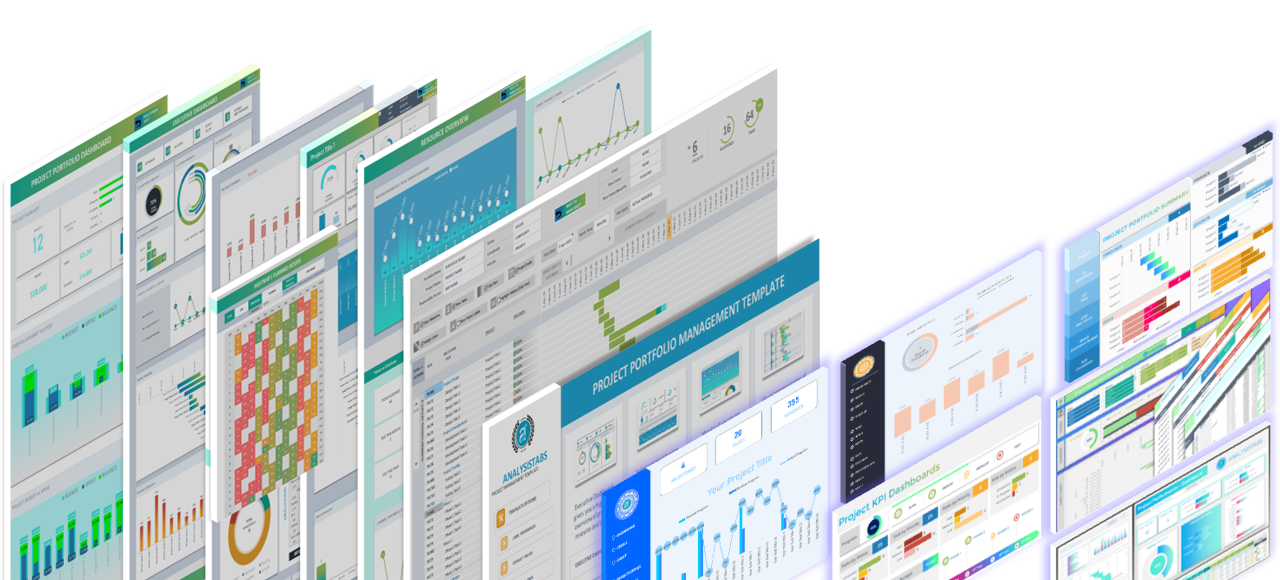
💡 From Analysistabs & ExcelX Every template we build in this series is available as a free download at Analysistabs.com and ExcelX.com — used by thousands of project managers across the US and globally. Built from real projects. Not from textbooks.
Project Management Across Industries — Same Discipline, Every Time
One of the most valuable things I learned across a 20-year multi-industry career: the principles of project management do not change between industries. The vocabulary changes slightly. The regulatory environment changes. The stakeholder dynamics change. But the core discipline — define, plan, execute, track, close — applies everywhere.
| Industry | Typical Projects | What Makes It Unique | What Never Changes |
|---|---|---|---|
| 🏥 Healthcare | EHR implementations, hospital builds, clinical system rollouts | Clinical risk, regulatory compliance, change management at patient-care level | Scope, timeline, budget, stakeholders, risk |
| 🏦 Banking | Core system migrations, product launches, regulatory programmes | Regulatory deadlines are non-negotiable; data integrity is paramount | Scope, timeline, budget, stakeholders, risk |
| 🏗️ Construction | Office builds, infrastructure, fit-outs, civil engineering | Physical dependencies, weather, subcontractor chains, safety compliance | Scope, timeline, budget, stakeholders, risk |
| 💻 IT / Tech | Software launches, infrastructure, cloud migrations, digital transformation | Rapidly changing requirements, Agile/Waterfall tension, technical debt | Scope, timeline, budget, stakeholders, risk |
| 🏪 Retail | Store openings, ERP rollouts, supply chain upgrades, rebrands | Seasonal constraints, multi-site logistics, customer-facing go-lives | Scope, timeline, budget, stakeholders, risk |
Notice the last column never changes. That is the Iron Triangle — Scope, Time, and Cost — sitting at the heart of every project on earth, regardless of industry, size, or methodology.
🎯 Key Takeaways — The 90-Second Summary