
- ⬇ Free Download
- 📋 What Is It
- 🔍 What’s Inside
- 🚀 How to Use
- 🛠️ Create Your Own
- ⭐ Best Practices
- 💡 Excel Tips
- ❓ FAQ
- 💬 Comments
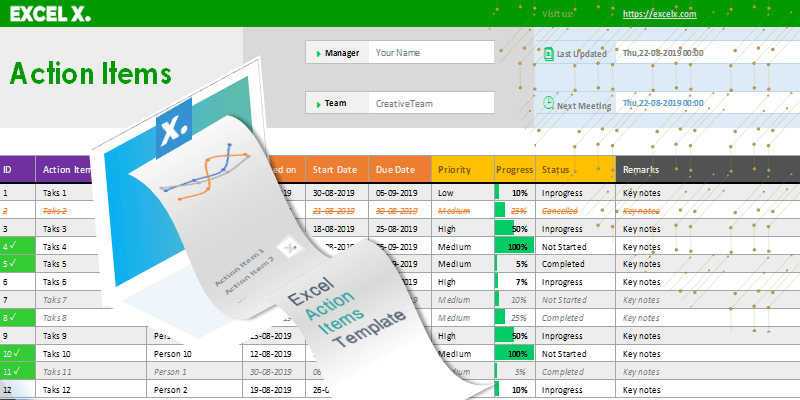
Download a free Excel Action Items Template to track tasks, assignments, deadlines, priorities, and progress. Includes ID, action item, assigned to, created date, start date, due date, priority, progress %, status, and remarks fields. Works in Excel 2016–365 and Google Sheets.
Free Action Items Template Excel: Download Now
Manage all your project activities and action items with this ready-to-use Excel template. Track tasks from creation to completion with built-in priority levels, progress tracking, and status management.
- Complete Task Tracking: ID, action item, assigned person, dates, priority, progress, status, and remarks in one organized table.
- Priority & Status Management: Dropdown validations for priority (Low/Medium/High) and status (Open/In Progress/Hold/Completed).
- Team & Meeting Info: Header section for manager name, team name, last updated date, and next meeting date.
What Is an Action Items Template?
An action items template is a structured document used to track and manage tasks that need to be completed by a team or individual. It captures what needs to be done, who’s responsible, when it’s due, and what the current status is — all in one centralized location.
Action items typically come from meetings, project reviews, stakeholder discussions, or retrospectives. Without a centralized tracker, these tasks get lost in email threads, chat messages, and forgotten sticky notes. This template ensures every action item is documented, assigned, and followed through to completion.
The template promotes accountability, clarity, and efficiency — everyone involved knows exactly what needs to be done and by when. It’s particularly valuable in organizations where multiple team members attend meetings and walk away with different interpretations of who’s doing what.
Unlike a full project plan which tracks the entire project lifecycle, an action items template focuses on the immediate, short-term follow-ups that keep day-to-day work moving. Think of it as the operational layer beneath your project plan — the template that captures every “I’ll get back to you on that” and turns it into a trackable commitment.
Common use cases include weekly team meetings, client calls, project steering committees, sprint retrospectives, vendor coordination sessions, and any situation where decisions are made and follow-ups are needed.
What’s Inside This Template
The template is organized into two sections — a Team Details header at the top and the main Action Items tracking table below. Together, they give you everything you need to capture, assign, and follow through on every task that comes out of your meetings and reviews.
Team Details
The header section captures your project context so anyone opening the file immediately knows which team and project it belongs to.
- Manager: Name of the team or project manager responsible for delivery. This is the person who owns the action items list and is accountable for ensuring items get completed. If your project has a dedicated PM, enter their name. For smaller teams, this might be the team lead.
- Team: Name of the team working on the project. Useful when multiple teams share a workbook or when the file is shared with stakeholders outside the immediate team — they can instantly see which group this tracker belongs to.
- Last Updated: Date the document was last modified. This is critical for version control — when someone opens the file, they need to know whether they’re looking at current data or a stale copy from three weeks ago. Update this every time you modify any action item.
- Next Meeting: Date of the next project meeting or review session. This creates urgency — team members can see when their items will be reviewed and plan accordingly. It also helps the meeting facilitator know when to prepare the review.
Action Items Table
The main tracking table contains nine fields for each action item. Here’s what each field does and how to use it effectively.
Action Item
The title or description of the task to be completed. Write this as a specific, actionable outcome — not a vague activity. “Send revised proposal to client” is better than “Proposal stuff.” Keep it concise but clear enough that the assignee knows exactly what to deliver without asking for clarification.
Assigned To
The single person responsible for completing this task. Always use an individual name, never a team or department name. “Sarah Chen” is accountable; “Marketing team” is not. If the task requires collaboration, assign it to the person who will coordinate and deliver the final output.
Created On
The date when the action item was first documented — typically the meeting date where it was discussed. This creates an audit trail showing how long items have been open. Items that have been open for weeks without progress may need escalation or re-prioritization.
Start Date
When work on the activity should begin. This is especially important for items that can’t start immediately — for example, a task that depends on another deliverable being completed first. Setting a realistic start date prevents the false impression that all items should begin immediately.
Due Date
The deadline to complete the action item. Every item must have a due date — an action item without a deadline is a wish, not a commitment. Set this during the meeting while context is fresh and the assignee can push back if the timeline is unrealistic.
Priority
Level of importance: Low, Medium, or High. Use the dropdown to maintain consistency. Be disciplined — if everything is High priority, nothing is. Reserve High for items that block other work or have external deadlines. Medium for important but flexible items. Low for nice-to-haves.
Progress
Percentage of the activity completed, from 0% to 100%. Update this before each meeting so the team can see real progress. Use round numbers (0%, 25%, 50%, 75%, 100%) for simplicity. Combined with conditional formatting, this gives an instant visual status across all items.
Status
The current state of the task, selected from four options: Open (not started), In Progress (work underway), Hold (paused due to blocker or dependency), or Completed (done). The dropdown validation ensures consistent data entry, making it easy to filter and sort by status during meeting reviews.
Remarks
Free-text field for any additional context — blockers, dependencies, related documents, decisions made, or notes from the assignee. This is where you capture the “why” behind delays or the “what” behind completed items. Use it liberally; future you will thank present you for the context.
Get all free PM templates delivered to your inbox
How to Use This Template
-
Download and openClick the download link above and open in Excel (2016 or later) or Google Sheets. Go to the ‘Action Items Template’ worksheet.
-
Fill in Team DetailsEnter your manager name, team name, last updated date, and next meeting date in the header section.
-
Add your action itemsEnter each task in the Action Item column. Be specific — “Draft Q3 marketing brief” is better than “Marketing work.”
-
Assign ownershipEnter the responsible person’s name in Assigned To. Use individual names, not team names — “Sarah” is accountable, “Marketing team” is not.
-
Set dates and priorityEnter start date, due date, and select priority level (Low/Medium/High) from the dropdown.
-
Track progressUpdate the progress percentage and status as work progresses. Use this in weekly meetings to review outstanding items.
-
Add remarksUse the Remarks column for blockers, dependencies, or any context that helps the assignee complete the task.
How to Create Your Own Action Items Template in Excel
-
Open a new workbookOpen Microsoft Excel and create a new workbook. Rename the sheet to “Action Items.”
-
Create column headersAdd: Item #, Action Item, Description, Assigned To, Created On, Start Date, Due Date, Priority, Progress, Status, Remarks.
-
Add dropdown validationsUse Data → Data Validation → Allow: List for Priority (Low, Medium, High) and Status (Open, In Progress, Hold, Completed). See our Excel Features guide.
-
Apply conditional formattingColor-code by status: red for overdue, yellow for in-progress, green for completed. Highlight high-priority items in bold.
-
Add the team headerAbove the table, add fields for Manager, Team, Last Updated, and Next Meeting date.
-
Save as templateSave as an Excel Template (.xltx) so you can reuse it for every project. See our saving workbooks guide.
Action Item vs Task: What’s the Difference?
• Comes from a meeting, discussion, or review
• Usually short-term (days to 1-2 weeks)
• Has a single owner
• Tracked in this template
• Example: “Send revised proposal to client by Friday”
• Part of a project plan or WBS
• Can span weeks or months
• May have sub-tasks and dependencies
• Tracked in a Project Plan Template
• Example: “Complete frontend development (4 weeks)”
Use a Project Plan for the big picture (tasks, Gantt chart, milestones) and this Action Items template for the small, immediate follow-ups that come from meetings and reviews.
Recommended PM workflow
Best Practices for Managing Action Items
Bad: “Look into the budget issue.” Good: “Calculate Q3 budget variance and send summary to Sarah by Friday.” The more specific the action item, the less time is wasted clarifying what was meant. Every action item should answer: what exactly needs to be done, and what does “done” look like?
“Marketing team will handle it” means no one handles it. Every action item needs a single named person who is accountable for completion. That person can delegate subtasks, but they own the outcome and the deadline.
An action item without a due date is a wish, not a commitment. Set the deadline during the meeting while the context is fresh and the assignee can push back if the timeline is unrealistic. Avoid setting all items to “ASAP” — prioritize with actual dates.
Start each meeting by reviewing outstanding action items from the previous session. This creates a rhythm of accountability — people know their items will be checked, so they’re more likely to complete them on time. Close completed items and carry forward anything still in progress.
Meeting notes capture the discussion. Action items capture the commitments. Mixing them together makes both harder to find. Use this template as a standalone tracker that persists across meetings — not buried inside a meeting document that gets filed away and forgotten.
Excel Tips for Action Item Tracking
Highlight the entire row in red when Due Date is past today and Status is not “Completed.” Formula: =AND($F2<TODAY(),$H2<>"Completed"). Apply to the full row range. See our Excel Features guide.
Use Data → Data Validation → Allow: List for Priority (“Low,Medium,High”) and Status (“Open,In Progress,Hold,Completed”). Prevents typos and makes filtering reliable.
Before each meeting, filter by Status = “Open” or “In Progress” to see only active items. Sort by Due Date to review the most urgent items first. Use keyboard shortcuts (Ctrl+Shift+L) to toggle filters quickly.
Add a summary row: =COUNTIF(H:H,"Open") to count open items, =COUNTIF(H:H,"Completed") for completed. Gives you an instant snapshot of how many items are outstanding. See our Formulas and Functions reference.
Common Mistakes to Avoid
- Vague descriptions: “Follow up with client” doesn’t tell the assignee what to follow up about. Be specific about the expected outcome.
- No due date: Every action item needs a deadline. Without one, items drift indefinitely.
- Group assignments: “Engineering will review” means nobody reviews. Name one person.
- Never closing completed items: Mark items as Completed when done. A list full of old completed items alongside active ones creates noise. Archive completed items monthly.
- Using email as your tracker: Action items assigned via email get buried. Centralize everything in this template and reference it in meetings.
- Too many high-priority items: If everything is High priority, nothing is. Be honest about what’s truly urgent vs important vs nice-to-have.
Frequently Asked Questions
What is an action items template?
A document used to track tasks that need to be completed — who’s responsible, when it’s due, and what the current status is. It captures follow-ups from meetings, project reviews, and stakeholder discussions.
What should be included in an action item?
At minimum: task description, assigned person, due date, and status. This template also includes priority level, progress percentage, start date, creation date, and remarks for additional context.
How often should I update action items?
Review and update at every team meeting — typically weekly. Update status and progress between meetings as tasks are completed.
Can I use this in Google Sheets?
Yes. Standard .xlsx file that opens in Google Sheets. All formatting and dropdowns work across platforms.
What’s the difference between an action item and a task?
Action items are short-term follow-ups from meetings (days to weeks). Tasks are planned work items in a project plan that can span weeks or months. Use this template for action items, and a Project Plan Template for tasks.
How do I prioritize action items?
Use the Priority column (Low/Medium/High). Focus on High priority items first. Sort the table by Priority, then by Due Date to see what needs attention immediately.
Can I track action items across multiple projects?
This template is for a single project. For tracking across multiple projects, use our Multiple Project Tracker for the big picture and maintain separate action item sheets per project.
What Excel features make this template better?
Dropdown validations prevent typos in Status and Priority. Conditional formatting highlights overdue items. Keyboard shortcuts speed up data entry. Excel formulas can automate due date calculations.
Related Templates
Project Plan Templates
9 free templates with Gantt chart and task tracking.
Multi-Project Tracker
Monitor multiple projects from one dashboard.
Project Charter
Define scope, stakeholders, and objectives.
Gantt Chart Templates
11 free timeline visualization templates.
RACI Matrix
52 templates to assign roles and responsibilities.
WBS Template
Decompose scope into hierarchical tasks.
Ready for Professional Project Power?
Need advanced dashboards, resource leveling, and workload capacity tools? Check out our Premium Project Templates.
What is the best way to add additional rows to the list and maintain the cell formatting?
Right Click on the Cell Then Hover On Insert and use the Table Rows Above Command:
Insert > Table Rows Above
Does the template support tracking multiple projects simultaneously?
Yes, you can create multiple tabs for different projects in the same file.
This template has made tracking my project tasks so much easier. Great work!
Thank you! We’re happy it’s simplifying your task tracking.