
What You’ll Learn in This Post
- The precise definition of a project deliverable — official and plain English
- The difference between internal and external deliverables
- How a deliverable differs from a milestone, a task, and an output
- Real-world deliverable examples across IT, construction, banking, and healthcare
- How to write clear deliverable descriptions that prevent scope disputes
- Why poorly defined deliverables are one of the top causes of project failure
A project deliverable is any tangible or intangible output that the project produces and delivers to a stakeholder. Whether it is a software system, a completed building, a report, or a trained workforce, every project exists to produce deliverables — and the clarity with which those deliverables are defined determines, more than almost any other factor, whether the project succeeds or fails.
In this post, we break down exactly what a project deliverable is, how it differs from related concepts like milestones and tasks, and how to define deliverables in a way that prevents disputes, scope creep, and late surprises.
What Is a Project Deliverable?
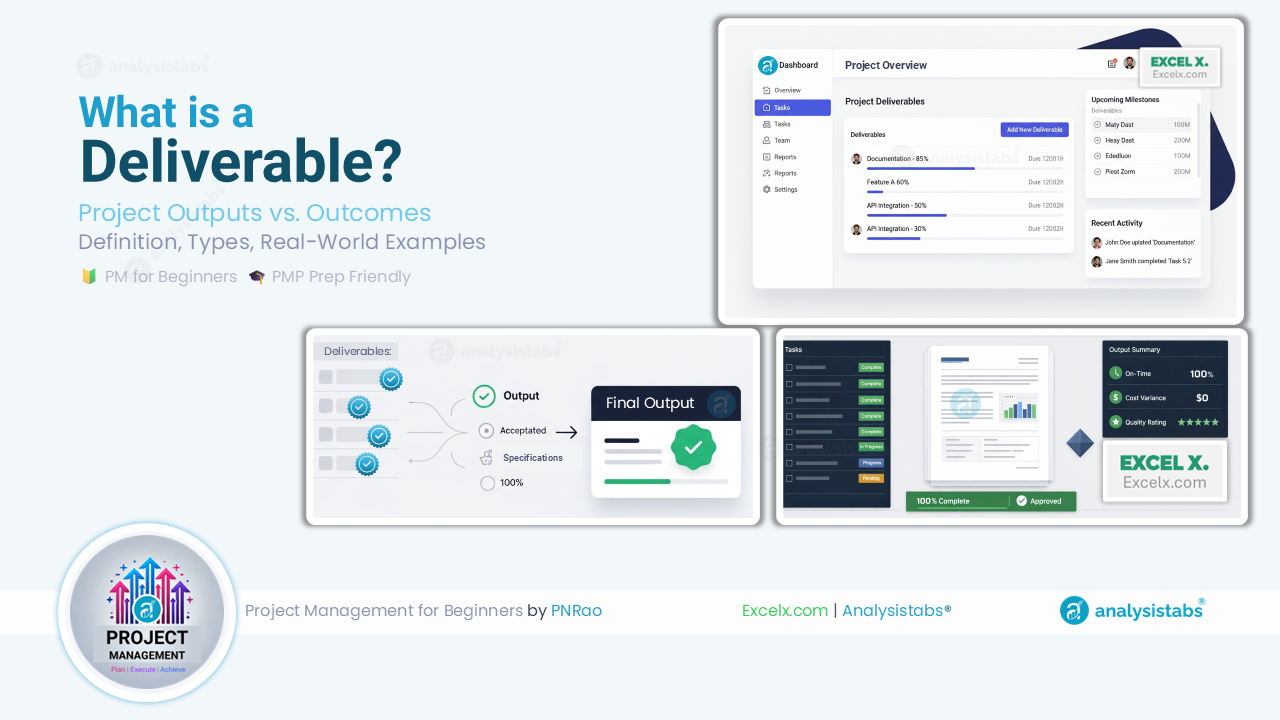
According to PMI, a deliverable is any unique and verifiable product, result, or capability that must be produced to complete a process, phase, or project. In simpler terms, it is the output that the project was commissioned to create — the “thing” handed over at the end of a phase or at project completion.
“Any unique and verifiable product, result, or capability to perform a service that is required to be produced to complete a process, phase, or project.”
— A Guide to the Project Management Body of Knowledge (PMBOK® Guide), Project Management Institute (PMI)
🧑💼 PNRao’s Plain English Version
A project deliverable is the specific output that the project must produce and hand over. It must be verifiable — meaning someone can review it, test it, or measure it against defined acceptance criteria — and confirm that it meets the agreed standard. If it cannot be verified, it is not a well-defined deliverable.
Two words in the PMBOK definition carry particular weight: unique and verifiable. Unique means it is the specific output of this project — not a generic category. Verifiable means there is a defined way to confirm the output is complete and acceptable. Together, these two properties are what make any project output useful as a management tool.
🎓 PMP Exam TipThe PMP exam distinguishes between project deliverables (the outputs of the project itself) and process deliverables (the outputs of project management activities, such as the project plan or risk register). Both are deliverables — but they serve different purposes and are managed differently throughout the project lifecycle.
Types of Project Deliverables
Project deliverables fall into two primary categories: internal and external. Understanding this distinction is important because each type is managed differently, has a different audience, and carries different accountability. Furthermore, the consequences of failure differ significantly between the two.
Further Categorisation by Output Type
Beyond internal and external, deliverables can also be categorised by what they actually are. The table below shows the four most common output types and illustrates each with real-world examples.
| Output Type | Description | Example |
|---|---|---|
| Physical product | A tangible item that can be touched, installed, or occupied | Completed office building, server rack installation, printed training manual |
| Digital product | Software, data, or a digital system delivered to the user | Deployed CRM system, migrated database, new company website |
| Service or capability | An operational function or trained capability handed to the business | Trained support team, established HR function, live helpdesk service |
| Document or report | A written output that records findings, decisions, or requirements | Business requirements document, compliance report, lessons learned log |
Deliverable vs Milestone vs Task
These three terms are frequently confused — even by experienced professionals. Understanding the distinction is, however, fundamental to building accurate project schedules and managing stakeholder expectations effectively.
Notice how the three concepts form a natural chain: a task produces a deliverable, and a milestone confirms the deliverable has been accepted. All three appear on a well-structured project schedule — and confusing them is one of the most common causes of poorly managed project plans.
PNRao’s Field TakeThe clearest test I use on any project schedule: if it takes time to do, it is a task. If it is the output of that work, it is a deliverable. If it is the moment someone confirms the output is accepted, it is a milestone. Apply these three filters to every item on your schedule and you will immediately eliminate the ambiguity that causes most tracking problems.
Real-World Project Deliverable Examples
Seeing project outputs across different industries reinforces the principle that each one is always a specific, verifiable result — not an activity or a general objective. The following examples span five sectors and show both the primary project output and the management output that supports it.
| Industry | Project Type | Project Deliverable | Management Deliverable |
|---|---|---|---|
| 💻 IT | CRM implementation | Deployed and tested CRM system with live user data | User acceptance test (UAT) results report |
| 🏗️ Construction | Office build | Completed and certified commercial office floor | Structural inspection certificate |
| 🏦 Banking | Core banking migration | All customer accounts migrated to new platform | Data migration reconciliation report |
| 🏥 Healthcare | EHR rollout | Electronic Health Records system live across all wards | Clinical readiness assessment sign-off |
| 🏪 Retail | New store opening | Fully fitted, stocked, and staffed retail store | Pre-opening checklist sign-off by regional manager |
| 📊 Finance | Regulatory compliance | IFRS 17 compliant reporting model in production | External audit sign-off confirming compliance |
How to Define a Project Deliverable Clearly
Poorly defined deliverables are among the top causes of scope disputes, missed deadlines, and stakeholder conflict. Therefore, writing a clear deliverable description — before the project begins — is one of the most valuable things a project manager can do.
The 4 Elements of a Well-Defined Deliverable
The deliverable must have a precise, unambiguous name — not a category or a goal. “New CRM System” is not specific enough. “Deployed Salesforce CRM, integrated with ERP and populated with migrated customer data, live in production environment” is a specific deliverable that everyone can picture clearly.
Acceptance criteria describe exactly what the output must do or contain to be considered complete and acceptable. Without these, “done” means something different to every stakeholder — and that ambiguity is what generates sign-off disputes at the end of a project. Criteria should be measurable: not “the system works well” but “the system processes 500 transactions per minute with zero data loss under load test conditions.”
Every deliverable must have a single named owner — the person accountable for ensuring it is produced to the required standard and on time. Ownership by a group or a team leads to diffused accountability, where everyone assumes someone else is managing it. As a result, critical outputs get missed.
The deliverable must have an agreed completion date and a named person with the authority to formally accept it. Knowing who can say “yes, this is done” is just as important as knowing what “done” means — especially for external deliverables where client sign-off triggers contract payments or regulatory obligations.
💡 Quick Deliverable Definition TemplateUse this format for every key deliverable: [Deliverable Name] — [What it is] — accepted by [Named Authority] — by [Date] — when [Acceptance Criteria are met]. For example: “UAT Sign-Off Report — a written test results document — accepted by the IT Director — by 30 April — when all P1 and P2 defects are resolved and 95% of test cases pass.”
Deliverables in the Project Plan and WBS
Deliverables are the building blocks of both the project plan and the Work Breakdown Structure (WBS). In fact, structuring a WBS around deliverables — rather than activities — is considered best practice because it keeps the focus on outputs rather than effort.
When you build your project plan around deliverables, every task on the schedule has a clear purpose: it exists to produce a specific, verifiable output. This makes it much easier to identify redundant work, spot missing tasks, and explain the schedule to stakeholders who are not project management practitioners.
On a regulatory reporting programme, the initial project schedule contained 340 tasks across four workstreams. However, when I mapped each task to a deliverable, 47 tasks had no clear output — they were meetings, reviews, and activities that produced nothing verifiable. Removing those 47 tasks, or redefining them as sub-tasks feeding into a real deliverable, reduced the schedule complexity by nearly 15% without removing a single piece of genuine work.
Furthermore, the cleaner schedule made it significantly easier for the steering committee to understand progress — because every item on the plan was directly traceable to something they could see, review, and approve. That visibility, consequently, increased sponsor confidence and reduced the frequency of unplanned escalation calls by more than half.
To get started with deliverable-focused project planning, download our free Project Plan Template and Work Breakdown Structure Template — both are structured around deliverables rather than activities, making them immediately usable for any project type.
For the full framework connecting deliverables to phases, schedules, and milestones, visit our Project Management Resource Hub. Additionally, the PMI PMBOK Guide provides the authoritative reference for deliverable management across all project types and industries.
🎯 Key Takeaways — The 90-Second Summary
Share This Story, Choose Your Platform!
80+ PREMIUM
Budget, Finance,
Calendars & Life
Planner Templates
→ Get Premium Templates
Take Control of Your Finances
Interactive dashboards, auto-calculations & visual breakdowns — starting from just $9.