
What You’ll Learn in This Post
- What project phases are — and why every project needs them
- The 5 standard phases of a project lifecycle, explained clearly
- What specifically happens — and what the PM’s job is — inside each phase
- The difference between project phases and PMBOK process groups
- Why skipping phases is one of the most common causes of project failure
- How phases relate to milestones, deliverables, and the project plan
Project phases are the structured stages that every project moves through from start to finish. Think of them as the chapters of a book — each one builds on the last, has a defined purpose, and must be substantially complete before the next one begins. Without clearly defined phases, projects tend to rush straight from an idea into execution, consequently skipping the planning and authorisation steps that prevent costly mistakes later.
In this post, therefore, we walk through the five standard project phases, explain what happens in each one, and show why this structure — even on small projects — makes the difference between controlled delivery and chaotic scrambling.
What Are Project Phases?
Project phases are distinct stages that divide a project’s lifecycle into manageable, sequenced segments of work. Each phase has a defined purpose, a set of activities, key deliverables, and — critically — an exit point that must be satisfied before the project moves forward.
Specifically, phases provide three things that unstructured work cannot: clarity about what is happening now, control over what starts next, and checkpoints where the sponsor or steering committee can formally review progress and decide whether to continue.
💡 Why Phases MatterA project without defined phases is like a construction site where the builders start laying bricks before the architect has finished the drawings. Work begins, but in the wrong order — and the cost of rework is enormous. Phases enforce the right sequence and ensure each stage is ready before the next one starts.
It is worth noting, however, that phases are different from the PMBOK’s five Process Groups (Initiating, Planning, Executing, Monitoring & Controlling, Closing). Process Groups describe types of management activity that happen throughout the project. Phases, in contrast, describe the structured stages of delivery work. We cover the distinction fully in What is Project Management?
The 5 Standard Project Phases
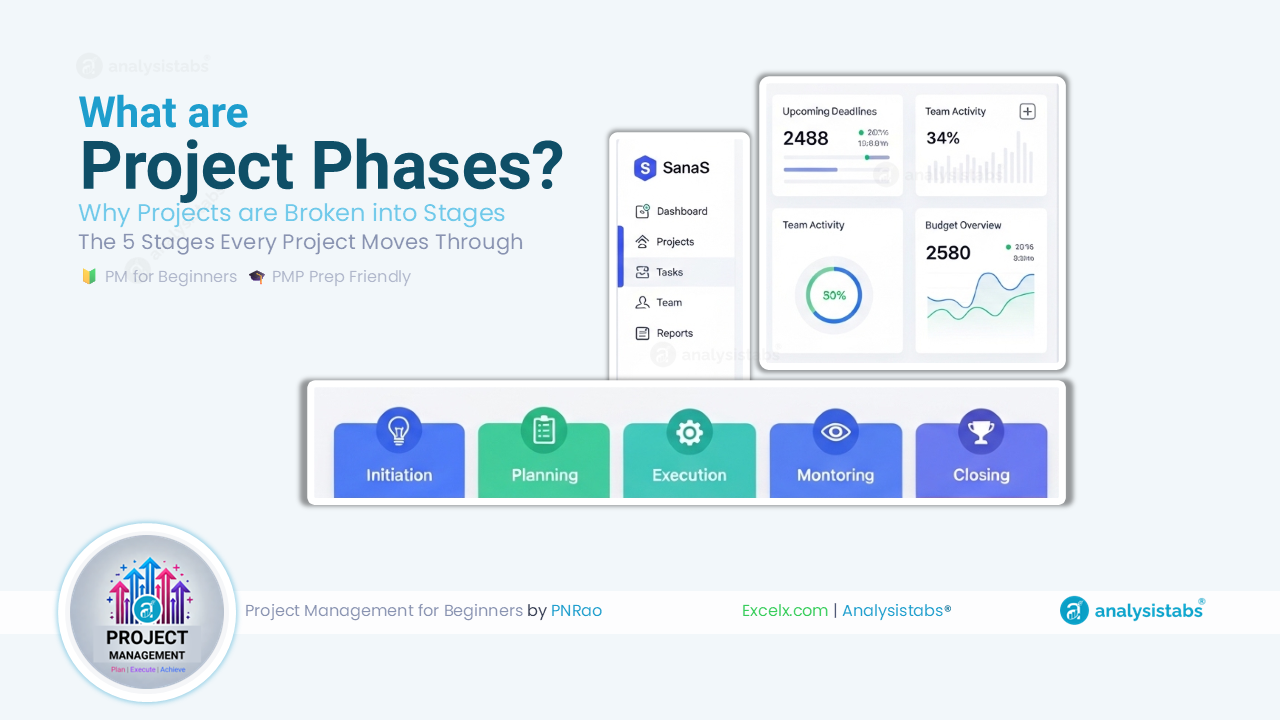
While different industries and methodologies use slightly different terminology, the five phases below represent the standard project lifecycle recognised by PMI and used across IT, construction, banking, healthcare, and retail projects worldwide. Regardless of industry, furthermore, the underlying sequence remains the same.
Notice that Monitoring & Controlling does not sit at the end — it runs in parallel with Execution throughout the entire project. This is, in fact, one of the most commonly misunderstood aspects of the project lifecycle for beginners. Meanwhile, the Closing phase is often skipped entirely, even though it is essential for formally releasing resources, capturing lessons learned, and preventing budget leakage.
Phase 1: Initiation
The Initiation phase is where a project is formally recognised and authorised to begin. Before this phase is complete, the project does not officially exist — it is simply an idea or a request. The primary output of this phase is, therefore, the Project Charter, a document that authorises the project and gives the project manager the authority to apply resources.
What Happens in Initiation
| Activity | Purpose | Who Is Responsible |
|---|---|---|
| Define the project objective | Establish what the project must achieve and why | Sponsor + PM |
| Identify key stakeholders | Understand who is affected and who has authority | PM |
| Conduct feasibility assessment | Confirm the project is viable within constraints | PM + Business |
| Define high-level scope and budget | Establish the outer boundaries of the project | Sponsor + PM |
| Produce and sign the Project Charter | Formally authorise the project to proceed | Sponsor (signs) |
The Initiation phase ends with a formal gate — typically sponsor sign-off on the Project Charter. Without this gate, projects frequently begin execution before the objectives are agreed, leading consequently to the scope confusion and budget overruns that characterise failed projects. See our free Project Charter Template to get started quickly.
🎓 PMP Exam TipThe primary output of the Initiation phase is the Project Charter. This document formally authorises the project and names the project manager. Without a signed charter, the PM has no formal authority — a critical point tested frequently on the PMP exam.
Phase 2: Planning
The Planning phase is, arguably, the most important of the five project phases. It is here that the team moves from a broad objective to a detailed, actionable roadmap. Consequently, time invested in planning pays back many times over during execution — because problems identified on paper are far cheaper to resolve than problems discovered during live delivery.
Key Planning Deliverables
⚠️ Common Planning MistakeMany teams treat planning as a one-time event — produce a plan, file it, and never look at it again. In reality, the plan is a living document that must be updated as the project progresses. A plan that does not reflect current reality is not a plan — it is a historical record.
Phase 3: Execution
The Execution phase is where the planned work is actually carried out. In terms of time, effort, and budget, this is typically the largest of the five project phases — it is where the team builds the product, implements the system, or delivers the service that the project was initiated to create.
Despite being the most visible phase, execution is not simply about “doing the work.” Rather, the project manager’s role during this phase is to coordinate the team, manage stakeholder communications, resolve blockers, and ensure that work is being completed to the required quality standard — not just being completed quickly.
The PM’s Core Responsibilities During Execution
Assign tasks, confirm resource availability, and ensure each team member knows their responsibilities and deadlines. Additionally, use action item logs to track commitments made in meetings. Our free Action Items Template simplifies this considerably.
Keep stakeholders informed, manage expectations, and handle escalations promptly. The communications plan built during Planning now becomes operational — status reports go out on schedule, steering committee updates are prepared, and concerns are addressed before they become blockers. Consequently, stakeholder surprises become far less frequent.
Verify that deliverables meet the acceptance criteria defined during Planning. Quality management during execution means checking work before it is presented for sign-off — not discovering problems after a formal review has failed. In other words, quality is built in, not bolted on.
Phase 4: Monitoring and Controlling
Monitoring and Controlling is the phase that runs alongside all others — particularly alongside Execution. Its purpose is to measure actual performance against the plan, identify variances early, and take corrective action before small problems become large ones.
This phase is, in many ways, the most important for a project manager’s credibility. Sponsors and steering committees do not expect projects to run perfectly — instead, they expect to be told promptly when things are off track and to see a credible plan for getting back on course.
What Monitoring and Controlling Involves
On a large CRM implementation, the development phase was tracking green on every weekly status report — until Week 9, when a detailed review revealed that “tasks completed” had been reported based on hours logged, not on working software demonstrated. In reality, approximately 40% of the functionality marked complete had not been tested and would not pass acceptance criteria.
The root cause was a failure of monitoring — specifically, the absence of a clear definition of what “done” meant for a development task. As a result of introducing a simple Definition of Done checklist in Week 10, the remaining work was properly controlled, and the project recovered to deliver within its original timeline. That single monitoring improvement saved an estimated 6-week delay.
Phase 5: Closing
The Closing phase is the most frequently skipped of all project phases — and that omission is more costly than most teams realise. When a project is not formally closed, budget lines remain open, team members stay assigned, lessons are never captured, and consequently the organisation repeats the same mistakes on the next project.
Formal closure does not mean the work simply stops when the last deliverable is handed over. Rather, it means completing a defined set of administrative, financial, and knowledge-management activities that wrap up the project properly.
Closing Phase Checklist
What Happens When You Skip Project Phases
Skipping project phases is one of the most common causes of project failure — and also one of the most preventable. Under pressure to show quick progress, teams frequently jump from Initiation straight to Execution, bypassing Planning entirely. As a result, the short-term gain of starting earlier almost always produces a long-term cost of rework, confusion, and schedule overrun.
PNRao’s Field TakeThe most expensive words in project management are “we’ll sort out the details as we go.” In 20+ years of PM, every project I have seen take that approach has paid for the missing planning phase at least twice over — once in rework costs and once in team morale. Phases exist because the sequence matters. The right work, done in the right order, produces a fundamentally different outcome from the same work done in a rush.
For a deeper look at how phases connect to the tools and templates that support each stage, therefore, explore our Project Management Resource Hub — including free downloadable templates for every phase of the project lifecycle.
Additionally, the PMI PMBOK Guide provides the authoritative reference for project phase structure across all industries and project types.
🎯 Key Takeaways — The 90-Second Summary
Share This Story, Choose Your Platform!
80+ PREMIUM
Budget, Finance,
Calendars & Life
Planner Templates
→ Get Premium Templates
Take Control of Your Finances
Interactive dashboards, auto-calculations & visual breakdowns — starting from just $9.