
What You’ll Learn in This Post
- The precise definition of project scope — official PMBOK and plain English
- The difference between product scope and project scope
- How to write a clear scope statement that prevents disputes
- What a scope baseline is and why it matters for change control
- Real-world project scope examples across IT, construction, and banking
- How poorly defined scope directly causes scope creep, budget overrun, and team burnout
Project scope is the defined boundary of what a project will — and will not — deliver. It is arguably the single most important definition in project management, because every other constraint — time, budget, resources, and quality — flows directly from it. Get the scope right at the start and the rest of the project has a stable foundation. Get it wrong, and no amount of skilled execution will save you.
In this post, we cover exactly what project scope means, how it differs from product scope, how to write a scope statement that sticks, and how to protect it once it is agreed.
What Is Project Scope?
According to PMI, project scope is the work that must be performed to deliver a product, service, or result with the specified features and functions. In practice, however, scope is best understood as a boundary — a clear line that separates what is inside the project from what is outside it.
“The work that needs to be accomplished to deliver a product, service, or result with the specified features and functions.”
— A Guide to the Project Management Body of Knowledge (PMBOK® Guide), Project Management Institute (PMI)
🧑💼 PNRao’s Plain English VersionProject scope is the complete list of what this project will deliver — and equally, what it will not deliver. Both halves of that definition matter. A scope that defines only what is included, without explicitly stating what is excluded, is an incomplete scope — and an incomplete scope is a direct invitation to scope creep.
Why “What Is Out” Matters as Much as “What Is In”
Most project teams spend considerable time listing what the project will deliver. Far fewer spend equal time explicitly documenting what is excluded. This asymmetry is costly. When scope boundaries are vague, stakeholders naturally assume that adjacent work is included — and by the time the misunderstanding surfaces, significant effort has already been committed to work the project was never meant to do.
🎓 PMP Exam TipThe PMP exam distinguishes clearly between product scope (the features and functions of the product being built) and project scope (the work required to deliver that product). Completion of product scope is measured against product requirements. Completion of project scope is measured against the project management plan. Both are tested — know the difference.
Product Scope vs Project Scope
These two terms are closely related but describe different things. Confusing them leads to gaps in planning and poorly structured project documentation. The table below clarifies the distinction with practical examples.
In practice, both scopes are defined during the Planning phase and together form the complete picture of what the project must achieve. Consequently, changes to product scope almost always affect project scope — and the change control process must therefore capture both.
How to Write a Project Scope Statement
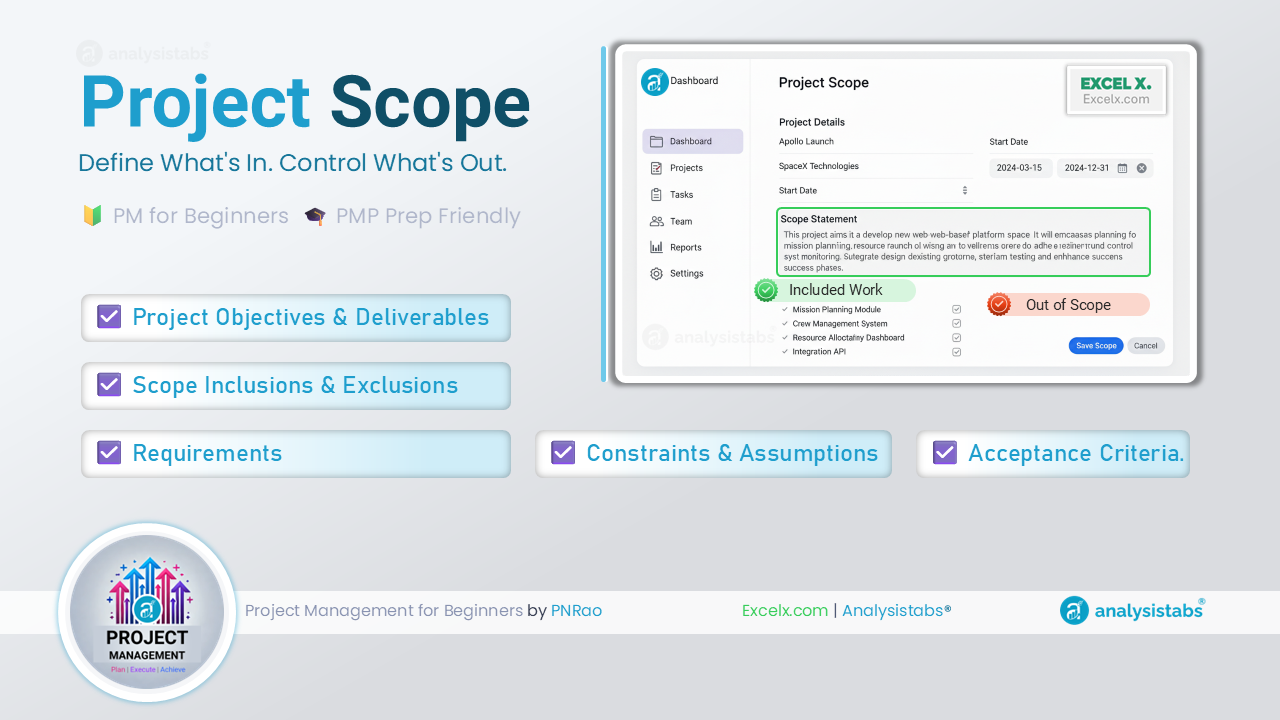
A scope statement is the formal written description of what the project will deliver and what it will not. It is, in essence, the contract between the project team and the stakeholders on the boundaries of the work. A well-written scope statement prevents the majority of scope disputes that arise during execution.
The 6 Elements of a Strong Scope Statement
A concise statement of what the project must achieve and why. This should be specific enough to evaluate success at the end — not a vague directional statement like “improve the system,” but rather a measurable outcome like “deploy the new ERP system to all 14 offices by 31 March with 99.9% uptime and zero data loss.”
An explicit list of everything the project will produce — systems, documents, trained staff, physical assets, or approved reports. Each deliverable should be named specifically. Vague categories like “training materials” leave room for disagreement; “12 role-specific training modules in PDF and video format” do not.
A written list of what is specifically out of scope. This section is often the most valuable part of the scope statement — because it closes the gaps that generate the most disputes. For example: “Post-go-live support beyond 30 days is excluded from this project and will be managed by the IT Operations team under a separate budget.”
The measurable conditions that must be met for each deliverable to be formally accepted. Without defined acceptance criteria, “done” means something different to every stakeholder. Consequently, sign-off disputes at the end of a project almost always trace back to acceptance criteria that were never written down at the start.
The boundaries within which the project must operate — fixed deadlines, budget caps, regulatory requirements, technology limitations, or resource availability restrictions. Documenting constraints upfront ensures that the team does not plan work that is structurally impossible to deliver within the agreed parameters.
The conditions that the project team is assuming to be true at the time of planning. For example: “It is assumed that the client will provide access to legacy system data by Week 3.” Documenting assumptions converts them from invisible risks into visible, manageable items — and protects the project if an assumption later proves false.
💡 Template TipOur free Project Plan Template includes a dedicated scope statement section covering all six elements above — ready to complete for any project type. Use it as your starting point and adapt the level of detail to the size of your project.
What Is a Scope Baseline?
Once the scope statement is agreed and approved, it becomes the scope baseline — the formally accepted version of the project remit against which all future changes are measured. The scope baseline is, therefore, one of the three components of the project baseline alongside the schedule baseline and cost baseline.
The scope baseline consists of three documents working together: the approved scope statement, the Work Breakdown Structure (WBS), and the WBS dictionary. Together, these three documents define exactly what the project will deliver, how the work is structured, and what each component means. Without all three, moreover, the baseline is incomplete.
📌 Why the Baseline MattersThe scope baseline is what makes change control possible. Without a formally approved baseline, there is no reference point for assessing whether a new request represents a change to the project or is simply work that was always included. Specifically, every change request is evaluated against the baseline — not against someone’s memory of what was originally agreed.
🎓 PMP Exam TipThe PMP exam tests the three components of the scope baseline specifically: the scope statement, the WBS, and the WBS dictionary. Know all three and understand that the scope baseline can only be changed through the formal Integrated Change Control process — not informally or verbally.
Real-World Project Scope Examples
Seeing project scope defined across different industries makes the concept concrete. The following examples show both what is in scope and — critically — what is explicitly out of scope for each project type.
| Industry | Project | In Scope | Explicitly Out of Scope |
|---|---|---|---|
| 💻 IT | CRM Implementation | Configure Salesforce, migrate 50,000 records, train 200 sales staff, go live by 30 June | Mobile app development, post-go-live support beyond 30 days, third-party integrations not listed in requirements |
| 🏗️ Construction | Office Fit-Out | Partition walls, flooring, lighting, HVAC, network cabling for floors 3–6 | Furniture procurement, IT equipment, external signage, car park works |
| 🏦 Banking | Core System Migration | Migrate all retail accounts to new platform, train branch staff, parallel run for 4 weeks | Business banking accounts (Phase 2), mobile app updates, decommissioning of legacy hardware |
| 🏥 Healthcare | EHR Rollout | Deploy system to 8 wards, migrate patient records, train clinical staff, go live | Outpatient clinics (separate project), billing system integration, GP surgery connectivity |
| 🏪 Retail | E-Commerce Platform | Build and launch new website, migrate product catalogue of 12,000 SKUs, integrate payment gateway | Warehouse management system integration, loyalty programme module, marketplace (Amazon/eBay) listings |
PNRao’s Field TakeNotice that the “Out of Scope” column in every example above is just as specific as the “In Scope” column. In fact, on many of the projects I have managed, the explicit exclusions generated more stakeholder discussion than the inclusions — because that is where the misaligned expectations were hiding. If a stakeholder pushes back on an exclusion, that is not a problem — it is important information. Better to surface it in a planning workshop than in a steering committee meeting six months later.
Project Scope and Scope Creep
Scope creep is what happens when a project’s agreed delivery boundary expands beyond what was originally defined — gradually, informally, and usually without any formal assessment of the impact on time, budget, or resources. It is, furthermore, one of the most common and costly problems in project management worldwide.
According to the PMI Pulse of the Profession, scope creep affects more than half of all projects globally. Organisations that fail to actively manage it, as a result, waste significantly more budget per project than those with robust scope control in place.
How Scope Creep Starts
💡 The Antidote to Scope CreepA clearly defined scope baseline, combined with a functioning change control process, is the only reliable defence against scope creep. When a new request arrives — regardless of who makes it — the response should always be: “That sounds valuable. Let me assess the impact on our schedule and budget, and we’ll raise a change request for sponsor approval.” That single habit, applied consistently, prevents the majority of scope creep on any project.
The Project Scope Management Process
Scope management is not a one-time activity — it is an ongoing process that runs from Planning through to project closure. According to Asana’s project scope guide, defining and managing scope consistently is one of the highest-impact habits separating high-performing teams from those that struggle. The process consists of six steps that together ensure the project delivers exactly what was agreed — no more, no less.
Steps 1–4 happen during the Planning phase. Step 5, in turn, runs throughout Execution as deliverables are completed and presented for acceptance. Step 6, meanwhile, runs continuously from project start to project close — it is not a final-phase activity.
On a multi-workstream digital transformation programme, the original scope statement ran to three paragraphs — high-level, vague, and missing any explicit exclusions. By Month 3 of execution, the team was building five features that appeared nowhere in the original brief. Each had been verbally requested in steering committee meetings and picked up by the development team without a formal change request.
When I was brought in to review the programme, the first action was to rewrite the scope statement with explicit inclusions and exclusions, get it signed off, and introduce a one-page change request process for anything outside it. Within six weeks, the rate of unplanned work dropped by over 70%. The programme subsequently delivered its core scope on time — a result that had seemed impossible three months earlier.
🎯 Key Takeaways — The 90-Second Summary
Share This Story, Choose Your Platform!
80+ PREMIUM
Budget, Finance,
Calendars & Life
Planner Templates
→ Get Premium Templates
Take Control of Your Finances
Interactive dashboards, auto-calculations & visual breakdowns — starting from just $9.