
What You’ll Learn in This Post
- The official PMBOK definition of a project — in plain English
- The 5 characteristics that every project must have to qualify as one
- The critical difference between a project and ongoing operations — and why mixing them up causes serious problems
- Real-world examples from IT, construction, banking, healthcare, and retail
- How to quickly test whether something you’re working on is actually a project
- Why the project definition matters for scope, budget, and team clarity from day one
So, what is a project — really? The word gets applied to everything from weekend DIY jobs to five-year infrastructure programmes. However, in professional project management, a project has a precise definition. Getting that definition right is not pedantry — it is, in fact, the foundation that everything else is built on.
If you cannot clearly define what a project is — and what it is not — you cannot define its boundaries, control its scope, or know when it is finished. That single confusion, furthermore, causes more budget overruns and missed deadlines than almost any technical problem in the field.
The Official Definition of a Project
According to PMI — the globally recognised authority on project management — the definition is straightforward but precise.
“A project is a temporary endeavor undertaken to create a unique product, service, or result.”
— A Guide to the Project Management Body of Knowledge (PMBOK® Guide), Project Management Institute (PMI)
🧑💼 PNRao’s Plain English VersionA project is a body of work with a defined beginning, a defined end, and a specific outcome that has never existed in exactly this form before. When those three things are present — temporary, unique, defined outcome — you have a project. When any of them is missing, you likely have something else entirely.
Breaking Down the Three Key Words
Three words in that definition carry all the weight: temporary, unique, and result. Every characteristic that distinguishes a project from other types of work flows directly from these three words. Therefore, it is worth unpacking each one carefully.
Temporary means the undertaking has a defined start and a defined end — not that it is short. A 10-year infrastructure initiative is still temporary because it has a finish line. Unique means the outcome has never existed in exactly this form before. Even your fiftieth store fit-out is unique because the specific combination of location, team, and constraints is new. Result, meanwhile, means the endeavour exists to produce something specific and measurable — not simply to keep people busy.
🎓 PMP Exam TipThe PMP exam tests the PMBOK definition precisely. Notably, “temporary” does not mean short, and “unique” does not mean unprecedented. Both terms carry specific meanings within the PMBOK framework — make sure you understand them as PMI defines them, rather than as everyday language might suggest.
The 5 Characteristics Every Project Shares
Regardless of industry, size, or methodology, every genuine project shares five core characteristics. Use these as a practical checklist when you are unsure whether something qualifies as a project or belongs in a different management category.
A project begins at a specific point and ends when its objectives are achieved, when it is cancelled, or when the need for it no longer exists. “Temporary” is the single most important word in the PMBOK definition. Without a defined end, you do not have a project — you have an ongoing operation, and that distinction matters for how you manage it, resource it, and measure its success.
No two projects are identical. Even when building your twentieth hospital ward or deploying your thirtieth retail outlet, the specific combination of site, team, regulatory environment, timeline, and constraints means the outcome is unique. This uniqueness is precisely why initiatives require active management — you cannot simply repeat what was done last time without assessment and adaptation.
Every undertaking needs a defined scope — a clear statement of what is included and, critically, what is not. Without defined scope, there is no boundary and no reliable way to measure completion. This is why scope creep is so damaging — it gradually erodes the defined boundary until the initiative no longer resembles what was originally agreed.
Every project consumes resources — financial, human, and temporal. An initiative without a budget is a wish. One without people assigned to it is a plan with no one to execute it. As a result, defining and managing resources is one of the core responsibilities of a project manager from the very first day.
Every project exists to produce a specific deliverable, outcome, or result — not to “do some useful things.” The goal must be specific and measurable enough to be evaluated at the end. Without a clear goal, you cannot define success, measure progress, or — perhaps most importantly — know when you are done.
💡 Five-Question Quick TestBefore starting any project, ask these five questions. If the answer to any of them is “no” or “we haven’t decided yet,” you are not ready to run it formally. Does it have a start date? An end date? A defined scope? Assigned resources? A specific, measurable goal? All five must be yes before the project charter is signed.
Project vs Ongoing Operations
This distinction causes the most confusion — and, consequently, the most damage — in organisations that do not understand it clearly. In contrast to a project, operations never end. They require different management approaches, different resource models, and different success criteria.
The Handover Point — Where Projects End and Operations Begin
One of the most important — and most commonly mismanaged — moments in any project is the handover to operations. This transition marks the point where the temporary team is released and the permanent operational team takes over. Without a clean handover, moreover, projects drag on indefinitely and operations never fully stabilise.
In a retail rollout covering 47 store openings across 18 months, each individual store opening was a project: it had a defined start (lease signed), a defined end (trading day one), a unique set of contractors, a site-specific budget, and a non-repeating combination of challenges.
Once each store opened, however, it transitioned immediately to operations — managed by a regional team with recurring KPIs, staffing rotas, and supply chain schedules. That clean handover from project to operations is something most organisations struggle to execute well. The ones that do it consistently, in contrast, see significantly lower post-launch costs and much higher team satisfaction on both sides of the transition.
⚠️ Common MistakeMany organisations treat ongoing operational improvement as a series of mini-projects — which consequently creates a permanent state of “project mode” with no stable BAU rhythm. If the work never ends, it is not a project. Give it an operational owner, an operational budget, and operational KPIs instead.
Real-World Project Examples by Industry
The most effective way to lock in the definition is to see it applied across industries. The following examples each demonstrate the three core attributes — temporary, unique, and aimed at a specific result — in a real-world context.
| Industry | Example Project | Temporary? | Unique? | Specific Result? |
|---|---|---|---|---|
| 💻 IT | Migrate 3,000 users from on-premise email to Microsoft 365 | Yes — ends on go-live day | Yes — specific org, data, and timelines | All users on M365, zero data loss |
| 🏗️ Construction | Design and build a 12-floor commercial office block | Yes — ends on handover to client | Yes — unique site, design, and specification | Completed building, certificate of occupancy |
| 🏦 Banking | Replace the core banking platform across all 280 branches | Yes — ends on final branch cutover | Yes — specific system, bank, and migration path | All branches live on new platform |
| 🏥 Healthcare | Implement an Electronic Health Records system across a hospital group | Yes — ends on clinical go-live | Yes — specific hospital workflows and data | EHR live, staff trained, legacy decommissioned |
| 🏪 Retail | Launch a new e-commerce platform to replace an existing website | Yes — ends on launch day | Yes — specific brand, catalogue, and integrations | New site live, old site retired, orders flowing |
| 📊 Finance | Implement IFRS 17 across the insurance group | Yes — ends on regulatory sign-off | Yes — specific org structure and reporting model | Compliant reporting by regulatory deadline |
PNRao’s Field TakeNotice that every example above has a clear finish line — not merely a direction. “Improve our systems” is not a project. “Migrate 3,000 users to M365 by 31 March with zero data loss,” however, clearly is. Making the finish line explicit before you start is one of the most valuable habits any project manager can develop.
What Is NOT a Project
Knowing what does not qualify as a project is equally important — and prevents a very common, costly mistake. The following are the most frequent things wrongly labelled as projects in organisations:
💡 Field Insight“Digital transformation” is consequently the phrase most likely to cause planning problems. It almost always means “we want things to be better but haven’t decided what, how, or by when.” The PM’s job is therefore to decompose the ambition into specific, bounded initiatives — each with a temporary timeline, unique scope, and defined result.
Types of Projects by Outcome
Projects are commonly categorised by the type of result they produce. According to the PMBOK, there are three primary output types: a product, a service, or a result. In practice, moreover, most project managers find it useful to distinguish a fourth — improvement projects.
| Project Type | What It Produces | Real Example | Primary Challenge |
|---|---|---|---|
| Product | A physical or digital item that can be used, sold, or delivered | New mobile banking app, hospital wing, retail fit-out | Scope definition and quality sign-off |
| Service | A capability or service offering delivered to a customer | IT managed services launch, new HR function, outsourced payroll | Defining acceptance criteria for something intangible |
| Result | An outcome or change in state — not a physical deliverable | Regulatory compliance programme, research study, policy implementation | Measuring success when the outcome is non-tangible |
| Improvement | A measurable enhancement to an existing process or system | Reduce invoice processing time by 40%, cut customer churn by 15% | Baselining current state and agreeing the improvement target |
🎓 PMP Exam TipThe PMP exam specifically uses the PMBOK’s three output types: product, service, or result. Of these, “result” is often the trickiest — it refers to an outcome or consequence (such as a research finding or regulatory approval) that is neither a physical product nor an ongoing service.
Projects by Size and Complexity
Projects span an enormous range of size and complexity. The core principles apply to all of them — however, the formality, tooling, and team structure should scale accordingly. Applying enterprise-level governance to a two-week initiative wastes time. Applying informal management to a multi-year programme, in contrast, causes chaos.
📌 Scaling PM to Project SizeA 2-person, 6-week initiative does not need a 40-page plan. Nevertheless, it still needs a clear goal, a defined end date, agreed scope, and a named owner. Scale the documentation to the undertaking — but never skip the fundamentals. A small initiative with no defined end and no owner is just as likely to run forever as a large one.
How a Project Moves from Start to Finish
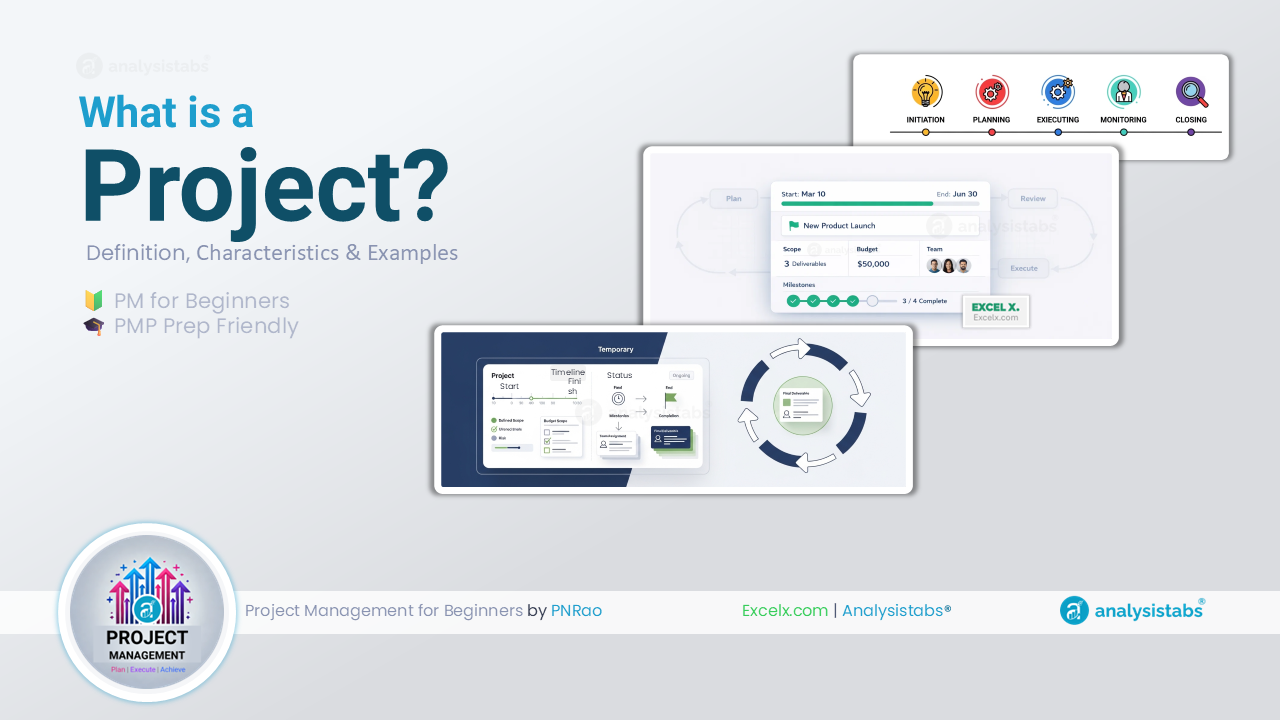
Regardless of size, industry, or methodology, every project moves through the same fundamental lifecycle. Understanding this lifecycle at a high level gives you a mental model for everything else in this series.
We cover this lifecycle in full detail in The 5 Phases of a Project Lifecycle. For now, notice that each phase has a purpose and a sequence — and that the Closing phase is just as important as any other. Initiatives that are not formally closed, moreover, continue consuming resources and budget long after they should have ended.
Why Getting the Definition Right Matters
This might feel like academic ground-clearing. In practice, however, getting the definition right — clearly, explicitly, before work begins — has direct and measurable consequences for every downstream activity in project management.
What Breaks When the Definition Is Fuzzy
A Real Consequence — From the Field
One ERP implementation I inherited had been running for 3 years with no signed project charter. The original scope had been defined verbally in a boardroom conversation. When I joined, moreover, four different spreadsheets were circulating — each one a different team’s version of what was supposed to be delivered.
The first action was therefore not to produce a new plan. Instead, it was to get everyone in a room and agree, in writing, on a single answer to one question: what is this project? That conversation — two hours, one document — immediately eliminated three months of scheduled work that nobody had explicitly agreed to, reduced the budget forecast by 18%, and gave the team a clear shared definition of done for the first time in three years.
That is the practical value of a clean project definition.
🎯 Key Takeaways — The 90-Second Summary
Share This Story, Choose Your Platform!
80+ PREMIUM
Budget, Finance,
Calendars & Life
Planner Templates
→ Get Premium Templates
Take Control of Your Finances
Interactive dashboards, auto-calculations & visual breakdowns — starting from just $9.