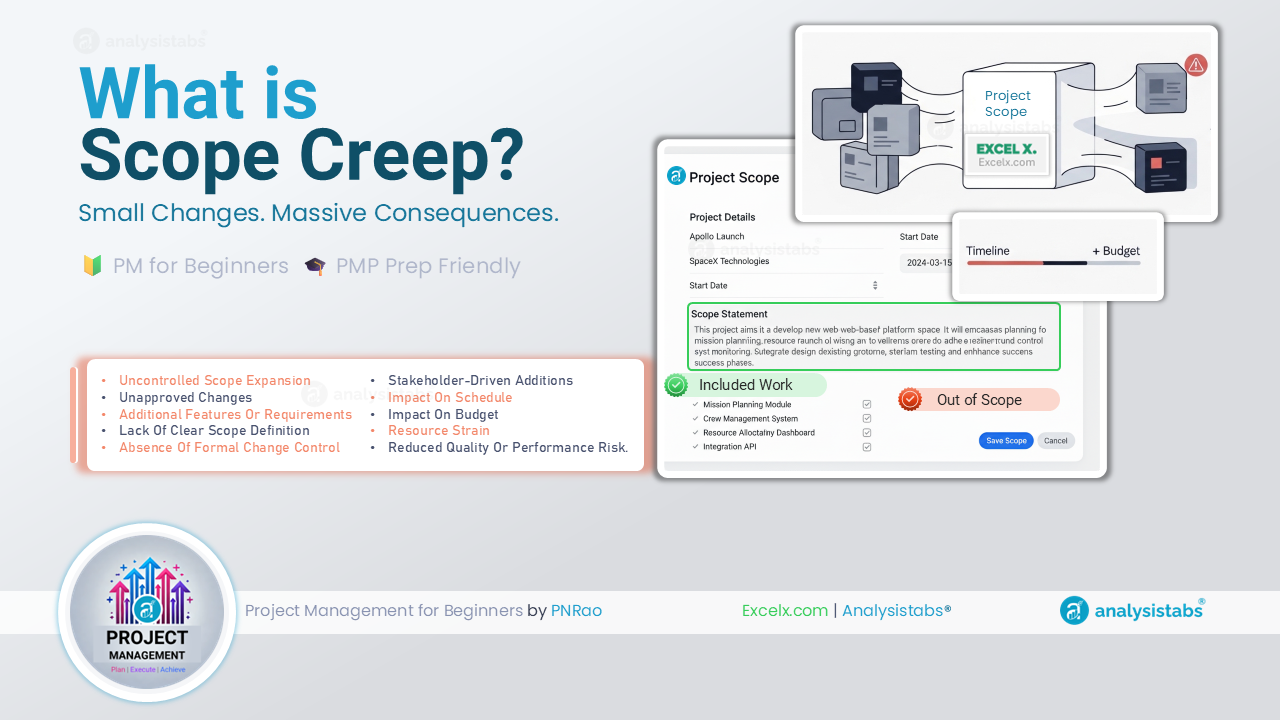
What You’ll Learn in This Post
- The precise definition of scope creep — and why it is so hard to see while it is happening
- The 5 root causes of scope creep that appear on almost every project
- Real-world scope creep examples from IT, construction, banking, and retail
- The warning signs that scope creep is already underway on your project
- A practical step-by-step prevention framework any PM can implement immediately
- The difference between scope creep and gold plating — and why both are dangerous
Scope creep is the gradual, uncontrolled expansion of a project’s agreed scope — one small addition at a time, usually without any formal assessment of the impact on time, budget, or resources. It rarely arrives as a single dramatic change. Instead, it accumulates quietly through informal requests, vague scope boundaries, and the natural human tendency to say yes to reasonable-sounding additions. By the time it is visible, the damage is already done.
In this post, we cover exactly what scope creep is, why it happens on even well-managed projects, how to recognise it early, and — most importantly — how to stop it.
What Is Scope Creep?
Scope creep occurs when a project’s scope expands beyond its agreed baseline without going through a formal change control process. The word “creep” is deliberate — it describes the gradual, incremental nature of how this problem grows. Each individual addition may seem minor and reasonable. Collectively, however, they can add weeks to the schedule, tens of thousands to the budget, and significant stress to the team.
“The uncontrolled expansion to product or project scope without adjustments to time, cost, and resources.”
— Project Management Institute (PMI), PMBOK® Guide
🧑💼 PNRao’s Plain English VersionScope creep is what happens when work grows beyond what was agreed — informally, incrementally, and without anyone formally assessing or approving the impact. The key phrase is “without adjustments.” If the budget, timeline, and resources are not updated to reflect new work, that new work is scope creep — regardless of who requested it or how reasonable it seemed at the time.
According to the PMI Pulse of the Profession, scope creep affects more than 52% of projects globally. It is, consequently, not an edge case — it is the default outcome when scope is not actively managed.
🎓 PMP Exam TipThe PMP exam distinguishes between scope creep (uncontrolled expansion without formal approval) and a scope change (a formally approved modification to the scope baseline via the Integrated Change Control process). Both result in added work — but only scope creep is a problem. A formally approved change is a managed decision.
Scope Creep vs Gold Plating
Scope creep and gold plating are related but distinct problems. Both result in work being done that was not in the original plan — however, they come from different directions and require different responses.
⚠️ Why Gold Plating Is Also a ProblemGold plating is often well-intentioned — but it is still uncontrolled work. Additional features consume budget, introduce new risks, require additional testing, and may not align with what the client actually wants. Delivering exactly what was agreed, to the required quality standard, is always preferable to delivering more than was asked for.
5 Root Causes of Scope Creep
Scope creep rarely has a single cause. In most cases, it results from a combination of structural weaknesses in how the project was set up and managed. The five causes below appear on almost every project where scope creep becomes a significant problem.
When the original project scope is written in vague, high-level language without explicit exclusions, stakeholders naturally fill the gaps with their own assumptions. Phrases like “improve the customer experience” or “modernise the platform” have no defined boundary — and therefore no defined end. Consequently, any related work can be argued as being “in scope.”
Without a defined change control process, new requests are picked up informally — in corridor conversations, email threads, or meeting actions — without anyone assessing the impact on schedule, budget, or resources. As a result, the project team simply absorbs the additional work until the cumulative effect becomes undeniable.
Senior stakeholders — particularly sponsors — can apply significant pressure to add features or expand deliverables without going through formal channels. Project managers who lack the confidence or authority to say “that requires a change request” become easy targets. Over time, moreover, informal agreement to one request sets a precedent that makes future refusals harder.
When requirements are not gathered thoroughly at the start, they emerge gradually during execution — each one expanding the scope. This is particularly common in IT projects where stakeholders only fully understand what they want once they see an early prototype. The solution is not to avoid iteration — rather, it is to control it through a formal requirements change process from the outset.
When multiple stakeholders have different mental models of what the project will deliver, each of them will, throughout execution, request work that aligns with their individual version of the scope. This is why stakeholder alignment workshops at the start of a project — before the scope baseline is signed off — are among the highest-value activities a project manager can facilitate.
Real-World Scope Creep Examples
Scope creep is easier to recognise in concrete examples than in abstract descriptions. The following scenarios are drawn from real project types across five industries — each one illustrating a different mechanism by which uncontrolled scope expansion takes hold.
| Industry | Original Scope | How Scope Creep Entered | Impact |
|---|---|---|---|
| 💻 IT | Implement CRM for the sales team | Marketing asked to be added mid-project; then customer service; then finance reporting module | 3-month delay, 40% budget overrun, go-live cancelled twice |
| 🏗️ Construction | Fit out floors 3–6 of office building | Client requested floor 7 “while contractors were on site,” then added a rooftop terrace | 6-week delay, £180k additional cost, contractor dispute |
| 🏦 Banking | Migrate retail accounts to new platform | Business banking accounts added “because the infrastructure is already being built” | Scope doubled; original timeline missed by 5 months |
| 🏥 Healthcare | Deploy EHR to 8 acute wards | Two outpatient clinics and the pharmacy system added verbally in a steering committee | Testing complexity tripled; clinical go-live delayed by 4 months |
| 🏪 Retail | Launch new e-commerce website with 12,000 SKUs | Loyalty programme, gift card module, and marketplace listings added one by one over 3 months | Budget exceeded by 55%; team worked excessive overtime; two developers resigned |
PNRao’s Field TakeNotice that in every example above, each individual addition seemed reasonable at the time. Nobody deliberately set out to wreck the project. Scope creep is almost never malicious — it is the natural result of human optimism, stakeholder enthusiasm, and the absence of a clear boundary. The boundary has to be maintained by the project manager, because nobody else will do it.
Warning Signs That Scope Creep Is Already Happening
The challenge with scope creep is that it is often invisible until it reaches a critical mass. By the time the schedule is visibly slipping or the budget is clearly overspent, weeks of uncontrolled growth have already occurred. The following warning signs appear earlier — and catching them early is what separates a controlled recovery from a project crisis.
💡 The Weekly Scope AuditOne of the most effective habits on any project is a weekly five-minute scope audit: review the week’s actions and decisions and ask — “Did we agree to do anything this week that is not in the scope baseline?” If the answer is yes, raise a change request immediately. This single habit, applied consistently, catches scope creep at the point of entry rather than months later.
How to Prevent Scope Creep: A Practical Framework
Preventing scope creep is not about being inflexible or refusing all change. Rather, it is about ensuring that every change is a deliberate, assessed, and approved decision — not an informal accumulation of additions. The framework below is practical enough to implement on any project, regardless of size or industry.
Step 1 — Define Scope Precisely Before Work Begins
The most powerful prevention tool is a well-written scope statement with explicit inclusions and explicit exclusions. Every item that could reasonably be assumed to be in scope — but is not — should appear in the exclusions list. See our guide on project scope for a full walkthrough of the six-element scope statement. Use our free Project Plan Template, which includes a structured scope statement section ready to complete.
Step 2 — Establish a Change Control Process on Day One
Before execution begins, define and communicate how scope change requests will be handled. The process does not need to be complex — a one-page change request form covering description, justification, impact on schedule, impact on budget, and sponsor approval is sufficient for most projects. Critically, furthermore, the process must apply to everyone — including the sponsor.
Step 3 — Communicate the Boundary to All Stakeholders
The scope boundary is only effective if everyone knows where it is. At project kickoff, walk through the scope statement with all stakeholders — including the exclusions list. When people understand the boundary explicitly, they are far more likely to route additional requests through the formal process rather than raising them informally in meetings.
Step 4 — Never Agree to New Work in the Room
The most important PM habit is a consistent response to in-meeting requests: “That sounds valuable — let me assess the impact and come back to you with a change request.” This is not a refusal — it is a professional commitment to evaluate properly. Stakeholders who respect the project will respect this response. Those who push back on it are precisely the ones who need to hear it most.
Step 5 — Review Scope Weekly and Rebaseline When Approved Changes Accumulate
Even with good change control, approved scope changes accumulate over time. Consequently, it is good practice to review the current scope baseline against the original at regular intervals — typically at each phase gate — and rebaseline formally when the volume of approved changes is significant. This keeps the project plan aligned with current reality rather than with a baseline that no longer reflects the project.
On an ERP implementation, a senior stakeholder joined the steering committee in Month 4 and began requesting reporting functionality that had been explicitly excluded from scope. Over the following six weeks, the team quietly absorbed four reporting modules — none through change control, because the PM was reluctant to challenge a senior sponsor.
At Month 6 review, those four modules represented approximately 11 weeks of unplanned development work and had introduced integration dependencies threatening the core go-live date. Resolving it required a formal steering committee conversation, a rebaselined schedule, and a supplementary budget request. The total cost of four informal “yeses” was a four-month delay and an £85,000 budget increase — entirely avoidable.
For a deeper reference on scope management best practices, Atlassian’s scope creep guide offers a practical companion perspective on controlling project boundaries in both traditional and agile environments.
Scope Creep in Agile Projects
A common misconception is that agile projects are immune to scope creep because they embrace change by design. In reality, however, the problem simply takes a different form — backlog bloat. New user stories and features accumulate continuously without reassessment of capacity or release timelines. Each addition is individually justified; cumulatively, however, they push delivery dates further and further right.
The underlying principle is therefore the same in both methodologies: every addition must be an assessed, deliberate trade-off — not an automatic yes. In agile, that trade-off is typically handled by the product owner, who must deprioritise or remove something else from the backlog when a new item is added.
🎯 Key Takeaways — The 90-Second Summary