
What You’ll Learn in This Post
- The precise definition of quality in project management — and why “good enough” is both the floor and the ceiling
- The three-stage quality management framework: quality planning, quality assurance, and quality control
- The difference between quality assurance (QA) and quality control (QC) — a distinction that is frequently confused and critically important
- What the cost of quality framework reveals about why preventing defects is always cheaper than finding them
- What gold plating is, why it is a quality failure — not a quality achievement — and how to prevent it
- Real-world quality examples across construction, banking, IT, healthcare, and retail
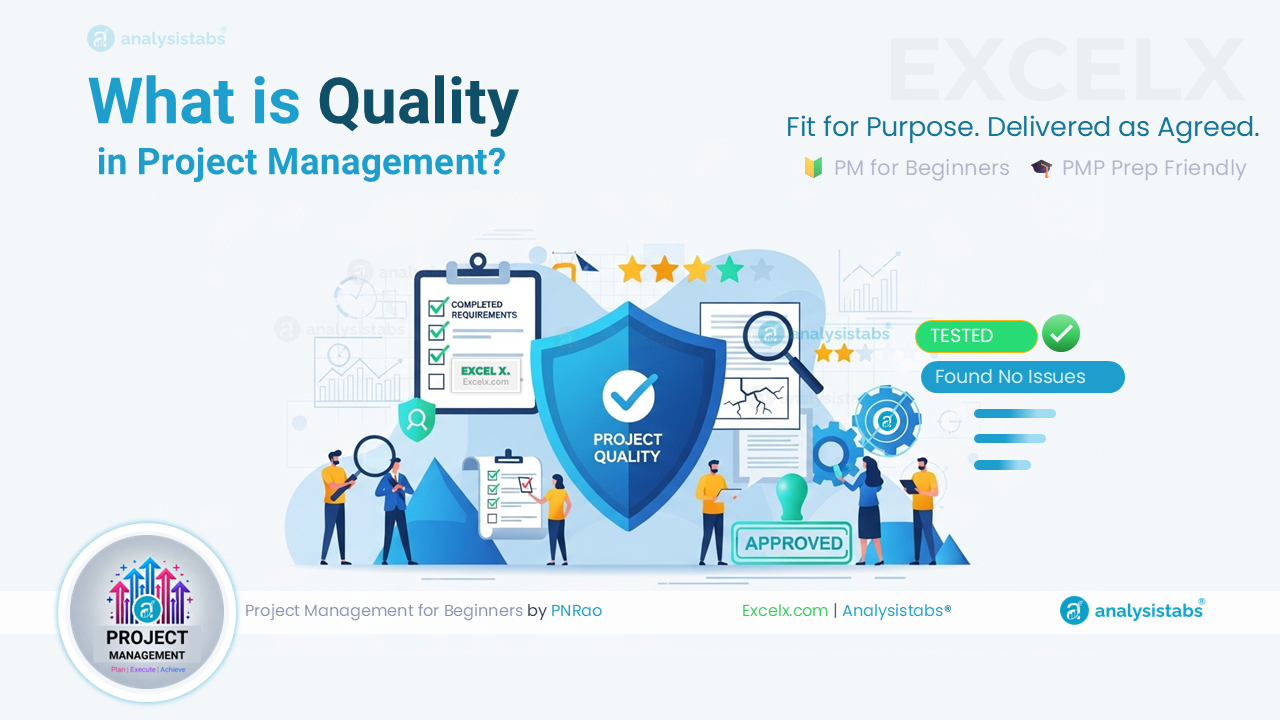
Quality in project management means the degree to which a project’s deliverables conform to the requirements, specifications, and standards that were agreed with the customer or sponsor at the start of the project. It is not about producing the best possible output — it is about producing the right output, to the right standard, the first time. A deliverable that exceeds the agreed specification by adding unrequested features is a quality problem, just as a deliverable that falls short of the specification is. Both cost the project time and money that should have been spent on delivering exactly what was agreed.
In this post, we define quality in project management precisely, explain the three-stage quality management framework, distinguish quality assurance from quality control, introduce the cost of quality model, explain gold plating and why it matters, and provide real-world examples across five industries.
What Is Quality in Project Management?
Quality in project management is defined by two complementary standards: conformance to requirements and fitness for purpose. Conformance to requirements means the deliverable matches what was specified. Fitness for purpose means it actually works as the customer intended in real-world use. A deliverable can conform to its written requirements but still fail the fitness-for-purpose test if the requirements were incomplete or poorly written — which is why quality management must begin at the requirements stage, not at the testing stage.
“The degree to which a set of inherent characteristics fulfills requirements.”
— A Guide to the Project Management Body of Knowledge (PMBOK® Guide), Project Management Institute (PMI), citing ISO 9000
Quality in project management means delivering exactly what was agreed — not more, not less, and not something slightly different that the team thought was better. Ultimately, the customer defines quality — and the project team’s job is to meet that definition as efficiently as possible. A hospital system that works flawlessly but takes 8 seconds to load when the requirement was 2 seconds has a quality problem. A construction project that uses premium marble in a lobby where standard stone was specified also has a quality problem. Both represent a failure to deliver what was agreed.
Quality vs. Grade — A Distinction the PMP Exam Tests
Quality and grade are frequently confused — both in the exam and in practice. Understanding the difference prevents one of the most common quality planning errors: specifying the wrong standard for the project context.
The PMP exam tests the quality vs. grade distinction directly. Remember: low quality is always unacceptable; low grade may be perfectly acceptable if it was specified. The exam also tests precision vs. accuracy in quality measurement — precision means repeated measurements produce consistent results; accuracy means results are close to the true target value. A process can be precise but inaccurate (consistently producing the wrong result), or accurate but imprecise (randomly hitting the target). High quality requires both precision and accuracy.
The Three-Stage Quality Management Framework
Quality in project management is managed through three distinct but interdependent activities — quality planning, quality assurance, and quality control. Each serves a different purpose and occurs at a different point in the project lifecycle. The most common quality management failure is over-investing in quality control (finding defects) while under-investing in quality planning and assurance (preventing them) — which is precisely backwards from the most cost-effective approach.
Quality Planning — Define the Standard Before Work Begins
Quality planning identifies the quality standards relevant to the project and determines how to satisfy them. It produces the quality management plan — a document that defines the quality objectives, the acceptance criteria for each deliverable, the standards and metrics that will be used, the tools and processes that will be applied to achieve and verify quality, and the roles and responsibilities for quality management across the project team. Quality planning must happen during the planning phase, before any delivery work begins. A quality standard defined after delivery has started is a standard that will be ignored under delivery pressure — because the team is already building to the implicit standard they assumed, and changing it mid-build is expensive.
Quality Assurance — Follow the Process That Produces Quality
Quality assurance (QA) is the ongoing audit of project processes to ensure they are being followed consistently and are capable of producing outputs that meet quality standards. QA is process-focused, not product-focused — it asks “are we doing things the right way?” rather than “did this specific output meet the standard?” Consequently, QA activities include process audits, methodology reviews, lessons-learned sessions, and continuous improvement initiatives. Quality assurance is preventive by nature: it reduces the probability of defects occurring in the first place by ensuring the processes that create deliverables are sound and consistently applied across the team.
Quality Control — Verify the Output Meets the Standard
Quality control (QC) is the inspection and measurement of specific deliverables to verify that they conform to quality requirements. QC is product-focused — it asks “does this specific output meet the standard?” rather than “are our processes capable of producing quality outputs?” QC activities include testing, inspection, peer review, defect measurement, and acceptance testing. Importantly, quality control finds defects after they have been created — which is why it is always more expensive per defect found than quality assurance, which prevents defects from occurring at all. The goal of a mature quality management approach is to minimize QC effort by maximizing QA investment.
The Cost of Quality — Why Prevention Is Always Cheaper Than Correction
The cost of quality (COQ) framework categorizes all quality-related costs into four buckets — two that represent investment in quality and two that represent the price of failure. Understanding this framework changes how project managers think about quality spending: the question is not “how much does quality cost?” but “are we spending quality dollars in the right places?”
| Cost Category | Type | Definition | Examples |
|---|---|---|---|
| Prevention Costs | Cost of Conformance | Costs incurred to prevent defects from occurring in the first place | Quality planning, process design, training, standards development, requirements reviews |
| Appraisal Costs | Cost of Conformance | Costs incurred to measure, evaluate, and audit outputs for conformance to standards | Testing, inspection, quality audits, acceptance reviews, performance measurement |
| Internal Failure Costs | Cost of Non-Conformance | Costs incurred when defects are found before the deliverable reaches the customer | Rework, scrap, retesting, defect analysis, re-inspection of corrected work |
| External Failure Costs | Cost of Non-Conformance | Costs incurred when defects reach the customer or end user after delivery | Warranty claims, customer complaints, emergency fixes, reputational damage, contractual penalties |
The cost of fixing a defect escalates dramatically at each stage of discovery. A requirements error caught during a planning review costs a fraction of the same error caught during development, which in turn costs a fraction of catching it during testing, which costs a fraction of the same defect reaching the customer after go-live. Research consistently shows that a defect discovered in production costs 50–100 times more to fix than the same defect caught at the requirements stage. This is the core economic argument for investing in quality planning and quality assurance — it is not about perfectionism; it is about spending quality dollars at the stage where they have the highest return.
The PMP exam tests the cost of quality framework directly. Remember that prevention costs and appraisal costs are “costs of conformance” — money spent to ensure quality. Internal and external failure costs are “costs of non-conformance” — money lost because quality failed. The exam also tests that the PM’s goal is to shift spending toward prevention and away from failure costs — because prevention costs are investments that reduce total quality spending, while failure costs are pure losses that generate no return.
What Is Gold Plating — and Why It Is a Quality Failure
Gold plating is the practice of adding features, enhancements, or capabilities to a project deliverable beyond what was specified in the requirements — without the customer’s knowledge or approval. It is almost universally well-intentioned: team members add “just a little extra” because they believe it will delight the customer. In reality, however, gold plating is a form of scope violation that wastes project resources, introduces untested risk, and often fails to produce the customer satisfaction it was intended to create.
Why Gold Plating Is a Problem
Gold plating consumes time and budget that was allocated for specified deliverables. The unspecified additions still require testing, documentation, and ongoing support — costs that were not included in the project plan. Furthermore, added features introduce new failure modes: an enhancement not in the requirements was also not in the test plan, meaning it reaches the customer untested. Additionally, gold plating sets a precedent that the team’s judgment about what the customer wants is more reliable than the customer’s own stated requirements — which undermines the entire requirements management process and makes scope baseline maintenance impossible over the course of a long project.
How to Prevent Gold Plating
Gold plating is prevented by maintaining a clear, baselined scope document and enforcing the change control process consistently — including for positive additions, not just for changes that reduce scope or extend the timeline. Specifically, any enhancement not in the original requirements must go through the formal change request process, regardless of how small it appears or how confident the team is that the customer will appreciate it. If the customer genuinely values the addition, it will be approved through the change control process and appropriate resources will be allocated. If it is not approved, the project team has been protected from spending time on something the customer did not actually want.
Gold Plating vs. Value Engineering
Gold plating should not be confused with value engineering — the legitimate practice of finding better ways to meet the specified requirements at lower cost or higher quality. Value engineering improves conformance to requirements; gold plating exceeds them without authorization. A developer who finds a more efficient algorithm that delivers required performance at half the processing cost is practicing value engineering. A developer who adds a personalization feature not in the requirements because it “seemed useful” is gold plating. The distinction matters because value engineering should be actively encouraged, while gold plating should be consistently redirected through the change control process regardless of how minor it appears.
In my experience, gold plating is most common on projects where the team has high technical confidence, strong pride in their work, and limited engagement with the customer during delivery. Teams build what they think is impressive rather than what was specified — and then discover at UAT that the customer wanted something different. The most effective prevention is not a stricter change control form — it is involving the customer frequently enough during delivery that the team’s instinct for what the customer wants is actually calibrated to reality. Weekly customer demos in agile projects dramatically reduce gold plating, not because of the governance, but because the team gets immediate feedback on whether their additions are valued before significant effort is sunk into them.
Quality in Project Management — Examples Across Five Industries
Quality in project management manifests differently across industries — the standards, measurement methods, and failure modes vary significantly by project type. However, the underlying framework — plan the standard, assure the process, control the output — remains consistent across all of them. The examples below show how quality management applies in real project environments and what the consequences look like when it is absent.
| Industry | Project Type | Quality Standard Defined | Quality Failure Mode | Cost of Non-Conformance |
|---|---|---|---|---|
| 🏗️ Construction | Hospital building | Structural steel specifications, fire safety compliance, HVAC performance tolerances | Concrete pour completed without required inspector sign-off; structural integrity issue identified 6 months later | Partial demolition and reconstruction of 3 floors — $2.1M remediation cost, 14-week delay |
| 🏦 Banking | Payment processing upgrade | Transaction accuracy: 100% (zero tolerance); processing time: ≤ 200ms; regulatory compliance: full | Rounding error in interest calculation logic not caught in testing — applied to 180,000 accounts at go-live | Regulatory investigation, customer remediation payments of $3.4M, reputational damage |
| 💻 IT / Software | E-commerce platform relaunch | Page load time ≤ 2 seconds under 10,000 concurrent users; checkout defect rate: 0 | Load testing conducted at 2,000 concurrent users, not 10,000 — platform failed under peak Black Friday traffic | 4-hour outage, $1.8M in lost transactions, emergency infrastructure scaling cost |
| 🏥 Healthcare | Drug dispensing system | Zero medication errors; audit trail on every dispensing event; alert response time ≤ 3 seconds | Alert suppression feature added by developer to reduce nurse interruptions — not in requirements, not tested, not disclosed (gold plating gone wrong) | Near-miss adverse event during clinical trial; full system rollback; 8-week re-validation program |
| 🏪 Retail | Inventory management system | Stock count accuracy: ≥ 99.5%; reorder trigger accuracy: 100%; system uptime: ≥ 99.9% | Quality planning completed but quality assurance skipped — data migration process not audited before go-live | 18% stock count inaccuracy at go-live; 3 weeks of manual reconciliation; $280,000 in inventory write-offs |
On a payment processing upgrade for a mid-size US regional bank, the project team had invested heavily in quality control — running more than 14,000 test cases across four test cycles before go-live. However, the quality assurance process had a critical gap: the requirements review cycle had been compressed from a planned 3 weeks to 5 days, because the project was already behind schedule at the planning stage. As a result, an edge case in the interest calculation logic for variable-rate savings accounts — affecting accounts that crossed a rate tier boundary within the same business day — was never captured in the requirements and consequently never tested.
At go-live, the error applied to 180,000 accounts over a 6-week period before an internal audit caught it. The remediation cost — including customer credits, regulatory reporting, external audit fees, and emergency development work — totaled $3.4 million against a total project budget of $2.1 million. Critically, the root cause confirmed by the post-incident review was not insufficient testing — it was insufficient requirements quality assurance. Subsequently, the bank mandated a minimum 15-day requirements review cycle on all payment-critical projects, with a QA sign-off required before any project could enter development regardless of schedule pressure. The lesson, learned at significant cost, was that compressing QA to protect the schedule ultimately destroyed both.
How to Manage Quality in Your Project — Practical Framework
Managing quality in project management effectively requires deliberate setup during planning and consistent discipline throughout delivery. The framework below translates the quality planning, assurance, and control model into day-to-day project management actions that any PM can apply regardless of project size or industry.
Define Acceptance Criteria for Every Deliverable
Every deliverable in the project scope must have documented, measurable acceptance criteria — the specific conditions that must be met for the deliverable to be accepted by the customer or sponsor. Acceptance criteria that are vague (“the system should be fast”) are functionally useless: they create disagreement at acceptance, because the team believes the deliverable meets the standard and the customer believes it does not. Specifically, acceptance criteria should follow the format: “Given [condition], when [action], then [measurable outcome].” For example: “Given 5,000 concurrent users, when the product search function is executed, then results must be returned within 1.5 seconds in 99% of cases.” Download our free Project Plan Template, which includes an acceptance criteria register as part of the project scope documentation.
Write a Quality Management Plan Before Development Begins
The quality management plan documents the quality standards, objectives, roles, tools, and processes that the project will use to achieve and verify quality. It is a formal planning document — not an afterthought or a template filled in to satisfy audit requirements. Consequently, a quality management plan written after delivery has started describes what was done rather than what will be done. At a minimum, it should cover: applicable quality standards, quality objectives and metrics, QA process descriptions, QC inspection and testing approach, defect management process, and the criteria for escalating quality issues to the sponsor or steering committee.
Invest in Prevention Before Testing
The cost of quality framework makes a clear recommendation: invest in prevention activities — requirements reviews, process training, design walkthroughs, and standards adherence checks — before investing in detection activities like testing. In practice, this means scheduling formal requirements reviews before development begins, peer reviews of design documents before they are baselined, and process audits at the start of each delivery phase. Moreover, these prevention activities must be included in the project schedule with real time allocations — not treated as optional overhead that gets squeezed out when delivery pressure increases, which is precisely when they matter most.
Track Quality KPIs Throughout Delivery
Quality in project management should be tracked through the same KPI framework used for schedule and cost — with defined targets, amber and red thresholds, and named owners. Key quality KPIs to track during delivery include defect discovery rate per sprint or per phase, test pass rate on first execution, rework rate as a percentage of total effort, and requirements change rate. A rising defect discovery rate in development testing is a leading indicator of quality problems that will surface — at much higher cost — in user acceptance testing or in production. Tracking it early gives the team time to investigate and address the root cause before the rework burden becomes unrecoverable.
Include a Quality Review in Project Lessons Learned
At project closure, the lessons learned review should include a dedicated analysis of quality performance — what quality problems occurred, at which stage they were detected, what they cost, and what process change would have caught them earlier or prevented them entirely. Furthermore, these quality lessons should be fed back into the organization’s quality standards and checklists, not simply filed in a project archive that nobody reads. The organizations that consistently improve their quality performance over time are those that treat project quality lessons as organizational learning — building institutional knowledge that makes each successive project better than the last.
🎯 Key Takeaways — The 90-Second Summary
I haven’t come across a more in-depth article on Quality in Project Management. Your explanation of Gold Plating as a quality failure is spot on—it’s a trap so many PMs fall into. The real-world examples across those five industries really help ground the concepts. This is definitely going into my bookmarks for when I need to draft a Quality Management Plan.