Your Quick-Reference PM Dictionary
- Definitions are in plain English first — technical precision follows
- Terms are grouped by topic area for faster lookup
- Each term links to a full guide where one exists in this series
- PMP exam relevance is flagged with 🎓 where the term is frequently tested
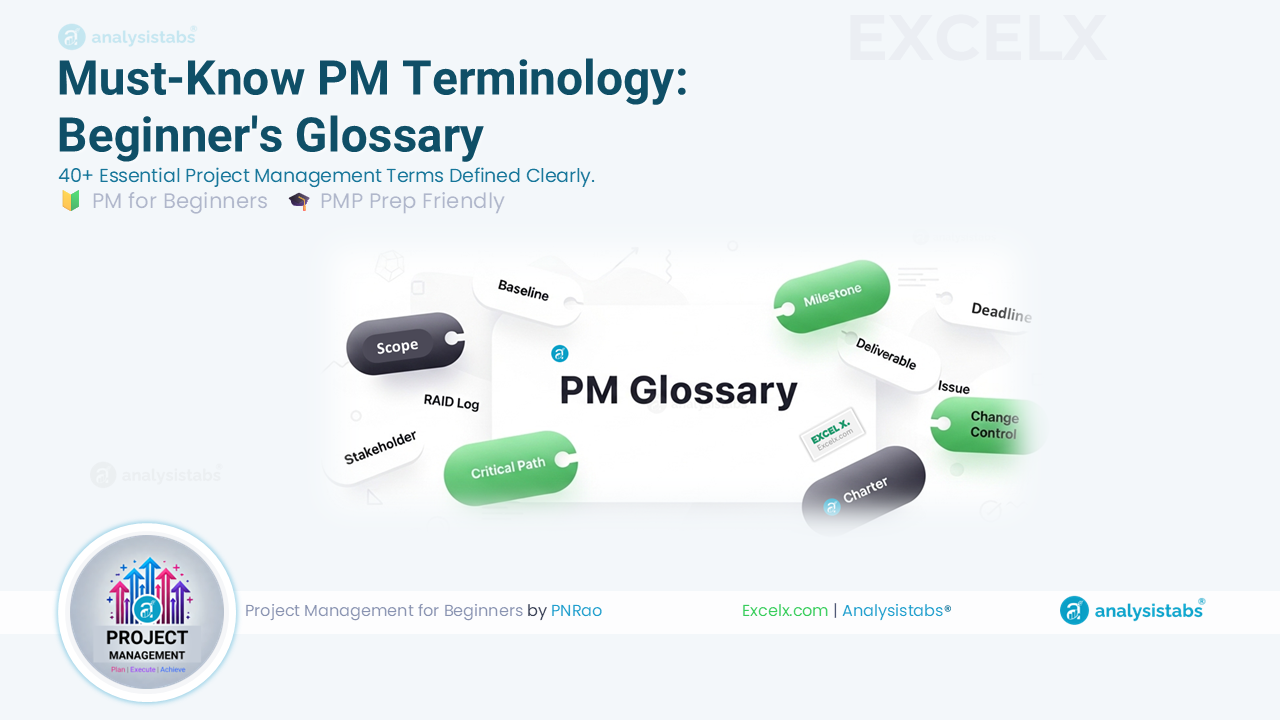
Every profession has its language — and project management has more than most. This glossary defines the 40+ terms that appear most frequently in PM conversations, courses, job descriptions, and the PMP exam. Each definition is written to be understood immediately, without assuming prior knowledge.
The Project — Core Concepts
These are the terms that define what a project is and how it is structured. Every other concept in project management builds on these — so they are the right place to start if any of the language in this series is new to you.
| Term | Plain-English Definition | Key Detail |
|---|---|---|
| Project 🎓 | A temporary effort to create something unique — a product, service, or result | Has a defined start and end date. Not ongoing operations. |
| Project Lifecycle 🎓 | The sequence of phases a project passes through from start to close | Typically: Initiation → Planning → Execution → Closure |
| Project Charter 🎓 | The document that formally authorizes the project and names the project manager | Issued by the sponsor. Required before planning begins. |
| Project Phase | A distinct stage of work within the lifecycle, each with its own outputs and review point | Examples: Design phase, Build phase, Testing phase |
| Phase Gate 🎓 | A formal review point between phases where the project is assessed before continuing | Also called a stage gate, kill point, or go/no-go decision |
| Deliverable 🎓 | Any measurable, tangible output the project must produce | Can be a document, system, product, report, or service |
| Milestone | A significant checkpoint in the project schedule — it marks the completion of a key event | Has zero duration. It is a point in time, not a task. |
| Go-Live | The moment a project’s output is deployed and available to its intended users | End of execution — not the same as project closure |
Scope, Schedule, and Budget
These terms cover the three primary constraints every project manager must balance — often called the Iron Triangle. Mastering the vocabulary in this group is the foundation of delivery management.
| Term | Plain-English Definition | Key Detail |
|---|---|---|
| Scope 🎓 | Everything the project must deliver — and the boundary of what it will not deliver | Defined in the scope statement and WBS. Underpins all planning. |
| Scope Creep 🎓 | Uncontrolled expansion of the project’s scope without a corresponding adjustment to time or cost | The most common cause of project overruns. Prevented by change control. |
| WBS (Work Breakdown Structure) 🎓 | A hierarchical breakdown of all work the project must do, organized into manageable chunks | Every deliverable traces back to a WBS element. The WBS is the scope baseline. |
| Baseline 🎓 | The approved, fixed reference version of the scope, schedule, or budget against which performance is measured | Three baselines: scope, schedule (timeline), cost (budget). Can only be changed via formal change control. |
| Deadline | The latest date by which the project or a specific deliverable must be complete | Distinguished from a milestone — a deadline carries a consequence if missed. |
| Schedule | The project plan that shows when each task will be done, by whom, and in what sequence | Built in tools like Microsoft Project, Excel Gantt charts, or Smartsheet |
| Budget | The total approved financial resources allocated to complete the project | Broken down by work package, phase, or cost category. Tracked against actuals. |
| Iron Triangle 🎓 | The three core constraints of every project: scope, time (schedule), and cost (budget) | Change one and the others are affected. Also called the Triple Constraint. |
| Critical Path 🎓 | The longest sequence of dependent tasks in the schedule — any delay here delays the whole project | Tasks on the critical path have zero float (no scheduling flexibility). |
| Float / Slack 🎓 | The amount of time a task can be delayed without delaying the project end date | Tasks on the critical path have zero float. Also called total float. |
Risk, Issues, and Change
Risk, issues, and change are the three most common sources of project disruption. Understanding the difference between them — and knowing the right response to each — is one of the most practical skills in day-to-day project management.
📌 Risk vs Issue — The Critical DistinctionA risk is something that might happen — it has not occurred yet. An issue is something that has happened and needs to be resolved now. Managing risks proactively is how you prevent issues. When a risk materializes — when the thing you were worried about actually happens — it becomes an issue and moves from the risk register to the issue log.
| Term | Plain-English Definition | Key Detail |
|---|---|---|
| Risk 🎓 | An uncertain event that, if it occurs, will affect the project’s objectives — positively or negatively | Risks can be threats (negative) or opportunities (positive). Both are managed. |
| Risk Register | The document that lists all identified risks, their probability, impact, and planned responses | A living document — updated throughout the project as new risks emerge. |
| Risk Appetite 🎓 | How much risk the organization or project sponsor is willing to accept in pursuit of the project’s objectives | Determines which risks require a response and which can be accepted. |
| Issue 🎓 | A problem that has already occurred and needs to be resolved for the project to proceed | Tracked in the issue log. Unlike a risk, an issue requires immediate action. |
| RAID Log | A single register tracking Risks, Assumptions, Issues, and Dependencies in one place | Commonly used in place of four separate logs. Updated at every status meeting. |
| Assumption | Something the project plan treats as true without confirmed evidence | Undocumented assumptions are a leading cause of scope disputes. Always log them. |
| Constraint | A fixed limitation the project must work within — budget cap, fixed deadline, regulatory requirement | Constraints cannot be negotiated. They shape what solutions are available. |
| Change Management 🎓 | The formal process for evaluating, approving, and implementing changes to the project’s approved baseline | Prevents scope creep. Every change request must be assessed for impact on scope, cost, and schedule. |
| Change Request 🎓 | A formal document requesting a modification to the project’s scope, schedule, or budget | Must be approved before the work is done. Approved changes update the project baseline. |
| Dependency 🎓 | A relationship where one task or deliverable cannot start or finish until another has been completed | Four types: Finish-to-Start (most common), Start-to-Start, Finish-to-Finish, Start-to-Finish. |
People and Governance
Projects do not run themselves — they run through people. This group covers the key roles, accountability structures, and governance mechanisms that determine who is responsible for what and how project decisions get made.
| Term | Plain-English Definition | Key Detail |
|---|---|---|
| Project Manager 🎓 | The person accountable for planning, executing, and closing the project | Responsible for scope, schedule, budget, quality, risk, and stakeholder management. |
| Project Sponsor 🎓 | The senior leader who champions the project, owns the business case, and has final authority over project decisions | The project manager’s escalation point. Signs off the charter and the final deliverable. |
| Stakeholder 🎓 | Anyone who is affected by the project or who can affect it — positively or negatively | Includes the sponsor, team, customers, end users, and impacted departments. |
| Steering Committee | The senior group that provides strategic oversight of the project and makes decisions beyond the project manager’s authority | Typically includes the sponsor and key business and IT leaders. Meets monthly or at phase gates. |
| PMO (Project Management Office) | A team or function that sets and maintains project management standards, tools, and governance across the organization | Can be directive (runs projects), controlling (enforces standards), or supportive (provides guidance). |
| RACI Matrix 🎓 | A responsibility assignment chart showing who is Responsible, Accountable, Consulted, and Informed for each project activity | Prevents confusion about who does the work vs. who owns the outcome. |
| Escalation | Raising an issue or decision to a higher authority when it cannot be resolved at the current level | A healthy governance mechanism — not a sign of failure. Delays in escalation cause most crises. |
Planning and Performance
These are the tools and measures project managers use to plan, track, and report on project performance. Understanding this vocabulary is essential for interpreting status reports, running effective steering committee meetings, and managing to a baseline.
| Term | Plain-English Definition | Key Detail |
|---|---|---|
| Project Management Plan 🎓 | The master document that describes how the project will be executed, monitored, and controlled | Covers scope, schedule, cost, quality, resources, communications, risk, and procurement. |
| Status Report | A regular update to stakeholders on the project’s progress, issues, risks, and forecast | Typically weekly or bi-weekly. Should include RAG status, accomplishments, and next steps. |
| RAG Status 🎓 | A traffic-light indicator showing whether the project is on track: Green (on track), Amber (at risk), Red (off track) | Should reflect actual performance — not optimism. Amber requires a mitigation plan. |
| KPI (Key Performance Indicator) | A measurable value that shows how effectively the project is achieving its key objectives | Examples: schedule variance, budget variance, defect rate, stakeholder satisfaction score. |
| Lessons Learned | A documented record of what went well, what went wrong, and what should be done differently on future projects | Produced at project closure. Often skipped — which is why the same mistakes repeat. |
| Acceptance Criteria 🎓 | The conditions a deliverable must meet before the customer or sponsor will sign it off as complete | Defined before execution begins. The benchmark against which all deliverables are tested. |
| Quality 🎓 | The degree to which the project’s deliverables meet the requirements and expectations of the customer | Quality is planned, assured, and controlled — not inspected in at the end. |
| Variance | The difference between what was planned and what actually happened — in schedule, cost, or scope | Positive variance (ahead of plan) or negative variance (behind plan). Tracked against the baseline. |
Hierarchy and Structure
These terms describe how projects, programs, and portfolios relate to each other and to the organization’s strategy. They appear frequently in governance conversations, PMP exam scenarios, and any organization managing more than a handful of projects simultaneously.
| Term | Plain-English Definition | Key Detail |
|---|---|---|
| Program 🎓 | A group of related projects managed together to deliver a benefit no single project could achieve alone | Temporary — closes when the strategic benefit is realized. |
| Portfolio 🎓 | The organization’s total collection of projects and programs, managed to execute strategy | Ongoing — no fixed end date. Success measured by strategic alignment and ROI. |
| Product | A deliverable created by a project that continues to exist and generate value after the project closes | A project lifecycle ends at closure; the product lifecycle continues until the product is retired. |
| Business Case 🎓 | The documented justification for a project — explaining the problem, the proposed solution, the expected benefits, and the estimated cost | Owned by the sponsor. The investment committee uses it to decide whether to fund the project. |
| Benefits Realization 🎓 | The process of ensuring that the benefits promised in the business case are actually achieved after the project delivers | A program management responsibility. Often neglected — benefits that are not measured are rarely realized. |
🎓 PMP Exam Tip — The Most Tested TermsThe terms most frequently tested on the PMP exam from this glossary are: baseline (scope, schedule, cost — and what changes them), critical path (longest path, zero float, end date impact), risk vs issue (might happen vs has happened), change request process (always evaluate impact before approving), and the project vs program vs portfolio hierarchy (temporary vs temporary vs ongoing, output vs benefit vs strategy). Knowing these five precisely answers the majority of scenario questions in the governance and planning knowledge areas.
🎯 Key Takeaways — The 90-Second Summary