What You’ll Learn in This Post
- The precise definition of a project lifecycle — official and plain English
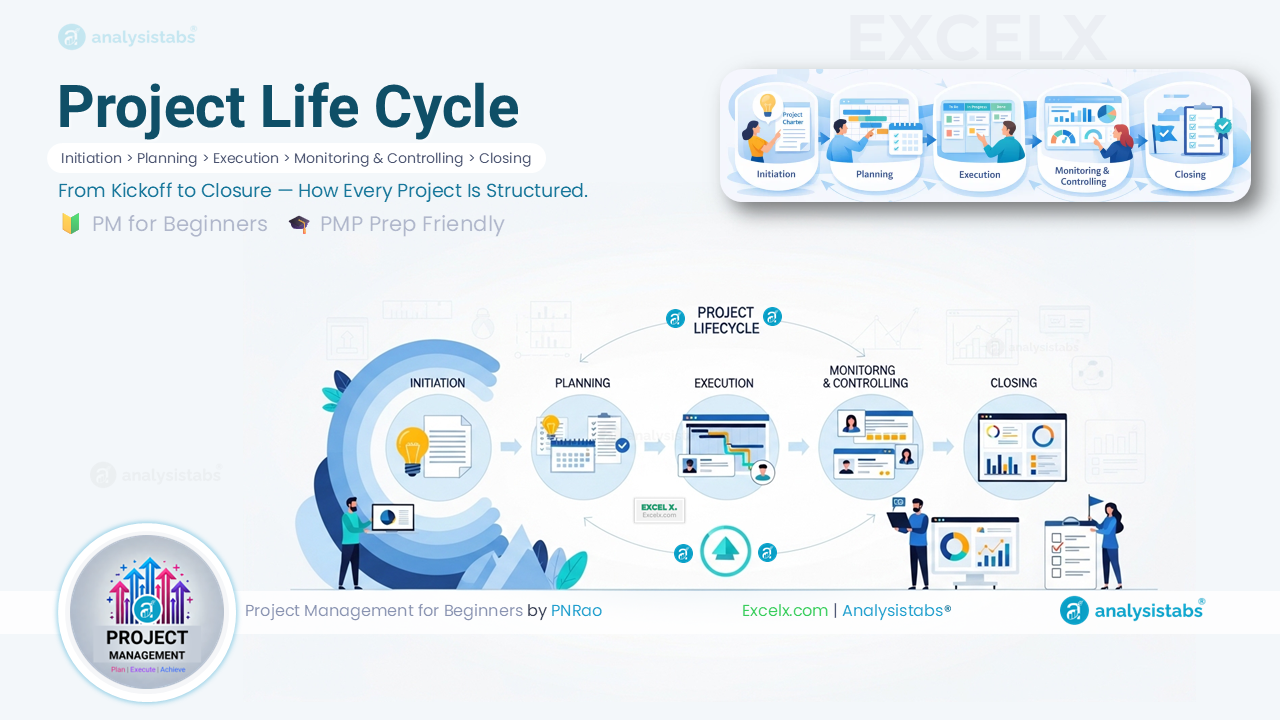
- The four main phases every project passes through
- The three types of project lifecycle — predictive, iterative, and adaptive
- How the project lifecycle differs from the product lifecycle
- How to choose the right lifecycle type for your project
- A real-world example of a project lifecycle in action
A project lifecycle is the sequence of phases a project passes through from initiation to closure. Every project has one — whether or not the team has consciously chosen it. The lifecycle governs how the project is planned, executed, monitored, and closed — and every PM tool, process, and governance mechanism operates within the context of a lifecycle phase.
In this post, we define the project lifecycle precisely, walk through its four main phases, explain the three types of lifecycle that exist and when each applies, and clarify the critical distinction between the project lifecycle and the product lifecycle — a distinction that the PMP exam tests frequently and that real organizations get wrong at significant cost.
What Is a Project Lifecycle?
The project lifecycle is the overarching framework that gives a project its structure — dividing work into defined phases that progress in sequence from project authorization to formal closure. Each phase has a clear purpose, defined outputs, and typically a gate or review point at which the project’s status and viability are assessed before work continues into the next phase.
“The series of phases that a project passes through from its start to its completion.”
— A Guide to the Project Management Body of Knowledge (PMBOK® Guide), Project Management Institute (PMI)
The Four Main Phases of a Project Lifecycle
While specific lifecycle models vary by industry and methodology, the vast majority are built on four foundational phases. These apply whether the project is building software, constructing infrastructure, launching a product, or implementing a business change. Understanding what each phase is accountable for — and what it produces — is the baseline knowledge all other PM frameworks build upon.
Phase 1 — Initiation
The initiation phase is where the project is formally authorized and its purpose defined. This phase answers the most important question any project faces: why does this project need to exist, and is the investment justified? The primary outputs are the project charter — which formally authorizes the project and names the project manager — and the initial stakeholder identification.
Initiation is the phase where many organizations invest too little time, with costly consequences. A project that moves into planning without a clear, agreed purpose — without a documented business case, a defined problem statement, or explicit executive authorization — is a project that is already at risk. The fastest projects are the ones where initiation was done thoroughly, because every subsequent phase benefits from the clarity that good initiation produces. The goals are set, the boundaries are understood, and the authority to proceed is explicit.
Phase 2 — Planning
The planning phase is where the team develops the detailed roadmap for achieving the project’s objectives. Planning answers the “how” questions: how will the scope be delivered, by whom, in what sequence, by when, and at what cost? The primary output is the project management plan — an integrated document covering scope, schedule, budget, quality, resources, communications, risk, and procurement.
Planning is not a one-time event at the start of a project — it is a continuous activity that is revisited and refined throughout the project as new information emerges. The plan produced in planning is a baseline, not a prediction. Its value is not that it will be followed exactly — it rarely is — but that it provides the reference point against which all subsequent performance is measured and all changes are evaluated. A project without a baseline has no way to know whether it is ahead or behind, over or under budget, or whether a proposed change is significant or trivial.
Phase 3 — Execution
The execution phase is where the project plan is put into action and deliverables are built, tested, and produced. Execution is typically the longest phase and the one that consumes the most resources — where the project manager spends most time coordinating teams, managing stakeholders, resolving issues, and monitoring performance against the baselines established in planning.
Execution and monitoring run in parallel throughout this phase — the project manager is not only directing work but continuously assessing whether the work being done is on track against the scope, schedule, and budget baselines established in planning. When deviations occur — and they always do — the project manager assesses their impact, determines whether they require a formal change request, and either resolves them within the project’s delegated authority or escalates them to the project sponsor or steering committee. The execution phase closes when the project’s deliverables have been completed and formally accepted by the customer or sponsor.
Phase 4 — Closure
The closure phase is where the project is formally ended — deliverables are transitioned to operations or the customer, contracts are closed, resources are released, and the project’s performance is documented and archived. Closure is the phase most commonly skipped or rushed, which costs organizations the institutional knowledge and lessons learned that make future projects more successful.
A properly executed closure phase does four things: it confirms that all deliverables have been accepted, all contracts have been closed, and all project resources have been released and redeployed; it produces a lessons learned register that captures what worked, what did not, and what future projects in the same domain should do differently; it archives all project documentation in a form that future teams can access; and it formally communicates project closure to all stakeholders so that no further project work is authorized against the closed project’s budget or scope.
Types of Project Lifecycle
Not all projects run their phases the same way. The three main types of project lifecycle reflect fundamentally different assumptions about how much is known at the start and how much will change during delivery. Choosing the right type is one of the most consequential early decisions a project manager makes.
| Lifecycle Type | Also Called | How It Works | Best For |
|---|---|---|---|
| Predictive | Waterfall, plan-driven, traditional | All phases are planned upfront; work progresses sequentially through each phase; scope is defined and baselined before execution begins | Projects where requirements are well understood and unlikely to change — construction, infrastructure, regulatory compliance, manufacturing |
| Iterative | Spiral, incremental | The project cycles through planning and execution repeatedly, with each iteration refining and building on the last; scope evolves based on feedback from each cycle | Projects where requirements are partially known but expected to evolve — research and development, complex technology builds, innovation projects |
| Adaptive | Agile, change-driven | Work is delivered in short, fixed-length cycles (sprints); scope is defined and reprioritized at the start of each cycle based on current priorities and customer feedback; the plan is continuously updated | Projects where requirements are highly uncertain or expected to change frequently — software products, digital platforms, customer experience redesigns |
Predictive Lifecycle — How It Works in Practice
In a predictive lifecycle, the team invests heavily in planning upfront — defining scope, building a detailed schedule, and locking down requirements before execution begins. The underlying assumption is that requirements are stable, the future can be planned reliably, and surprises can be anticipated and mitigated through rigorous upfront planning.
Predictive lifecycles work well when those assumptions hold. A bridge construction project, a regulatory reporting implementation, or a data center migration all have requirements that are knowable upfront and deliverables that can be specified precisely before work begins. They work poorly when requirements are uncertain or when the customer does not know exactly what they want until they see early versions of it — because the predictive lifecycle has no built-in mechanism for incorporating that kind of late-stage learning without triggering a costly change control process.
Iterative Lifecycle — How It Works in Practice
In an iterative lifecycle, the project does not define all requirements upfront. It plans a first iteration with currently understood requirements, delivers it, gathers feedback, and plans the next cycle accordingly. Each iteration produces a more refined version of the deliverable — and the final scope is better than anything specifiable before work began.
Iterative lifecycles are particularly effective in research and development contexts, where the solution to a problem cannot be fully specified before some experimentation has been done. They require a higher tolerance for scope evolution and a customer who is willing and able to engage actively in reviewing and refining each iteration — which is a governance commitment that must be explicitly planned for, not assumed.
Adaptive Lifecycle — How It Works in Practice
In an adaptive lifecycle, the full project scope is not defined upfront. A high-level backlog captures desired features, but only the next sprint — two to four weeks — is planned in detail. After each sprint, the customer reviews the delivered increment, the backlog is reprioritized, and the next sprint begins. Scope changes as the customer learns what they need.
Adaptive lifecycles require a different governance model than predictive ones. Traditional project success metrics — on time, on budget, exactly in scope — do not apply cleanly, because the scope is not fixed. The governance question shifts from “are we delivering what we planned?” to “are we delivering the most valuable possible output within the time and budget constraints?” This requires a product owner with clear authority to prioritize the backlog, a team with the technical skills to deliver incrementally, and a sponsoring organization comfortable with scope evolution as a feature of the delivery approach rather than a failure of project management.
Project Lifecycle vs Product Lifecycle
The project lifecycle and the product lifecycle are related but fundamentally different concepts, and confusing them leads to significant governance and accountability errors in practice. The distinction is worth understanding precisely because the two lifecycles operate on different time horizons, are governed by different roles, and measure success by different criteria.
Real-World Example — A Project Lifecycle in Practice
Lifecycle phase definitions become genuinely useful when traced through a real project — seeing exactly what work happens, what each phase produces, and how transitions between phases are governed. The example below follows a single project from initiation to closure, showing how the four phases operate in practice and where lifecycle management failures most commonly occur.
A regional airline identified that its 14-year-old crew scheduling system was creating significant operational inefficiency — manual workarounds were consuming 22 hours per week of scheduler time, and the system could not integrate with the new aircraft fleet management platform the airline had deployed the previous year. The operations director proposed a replacement project and received board authorization to proceed.
Initiation (6 weeks): The project manager was formally assigned and issued a project charter signed by the Chief Operating Officer. The charter defined the project’s objective (replace the crew scheduling system with a solution that integrates with the fleet management platform and eliminates the 22-hour manual workaround), the high-level budget authorization ($1.4M), the initial milestone dates, and the key stakeholders — including the crew scheduling team, the IT operations team, the pilots’ union liaison, and the fleet management platform vendor. A preliminary stakeholder analysis identified the pilots’ union as a high-influence, high-interest stakeholder whose early engagement would be critical to adoption. The phase gate at the end of initiation confirmed that the business case was sound and authorized the project to proceed into planning.
Planning (10 weeks): The project team worked with the scheduling department to document detailed requirements for the new system — 87 functional requirements and 14 integration requirements with the fleet platform. Three vendor solutions were evaluated against those requirements. The selected solution required a 14-month implementation timeline. The project management plan was developed covering scope, schedule (a 47-task Gantt chart with five major milestones), budget (broken down by vendor fees, internal resource time, data migration, testing, and training), risk register (top risk: data migration integrity from the legacy system), and a communications plan that included monthly briefings to the pilots’ union liaison. The planning phase gate confirmed that the plan was complete and approved, and the project was authorized to proceed into execution.
Execution (14 months): The vendor began configuration in month one. Data migration planning began in month two — and the team discovered that 11 years of historical scheduling data was stored in a format the new system could not directly import, requiring a custom migration tool that had not been included in the original scope. A change request was raised, approved by the steering committee, and added four weeks and $38K to the project. User acceptance testing in month 13 identified six critical defects and 14 minor ones — all were resolved within the three-week testing window. The pilots’ union liaison, who had been engaged throughout execution per the communications plan, confirmed that the union had no objections to the new system and would support the transition briefing to crew members.
Closure (4 weeks): The new system went live on schedule (after the approved four-week extension). Formal acceptance was signed by the COO and the scheduling department manager. The vendor contract was closed. The three internal project team members were formally released to their line managers. The project manager produced the final project report — final cost was $1.441M against the approved budget of $1.438M (0.2% over, within tolerance); the project delivered all 87 functional requirements and all 14 integration requirements; the 22-hour weekly manual workaround was eliminated within three weeks of go-live. The lessons learned register documented the data migration discovery as a risk category to include in future system replacement projects — and the project was formally archived and closed.
4 Common Project Lifecycle Mistakes
The mistakes below cluster around specific phases and transitions between them. Most trace to two root causes: the lifecycle was not consciously chosen at the project’s start, or a phase was abbreviated to save time — with that cost repaid later at far higher interest. Understanding where these patterns occur is the first step to preventing them.
Skipping or Rushing Initiation
Initiation is the phase most frequently compressed under schedule pressure and the one whose abbreviation most reliably causes downstream problems. When a project skips proper initiation — no charter, no agreed business case, no formal authorization — execution begins without a shared understanding of why the project exists, what its boundaries are, or who has authority to make decisions.
The result is a project that starts fast and slows down progressively as the team discovers that different stakeholders have different mental models of what the project is for, what is in scope, and what success looks like. These conflicts surface during execution — the most expensive phase in which to resolve them. Every hour saved by compressing initiation typically costs five or more hours in execution rework, scope disputes, and stakeholder conflict resolution. Initiation is an investment in clarity, not a bureaucratic overhead.
Treating Planning as a One-Time Event
Many project teams produce a plan during the planning phase and never revisit it — treating it as a completed artifact rather than a living document. When the plan diverges from reality and is not updated, performance reporting becomes meaningless, change requests cannot be evaluated against a current baseline, and stakeholders lose confidence in the project’s management.
Planning is a process that continues throughout the project lifecycle, not a phase that finishes before execution begins. The schedule, risk register, stakeholder engagement plan, and budget forecast should all be reviewed and updated at regular intervals throughout execution. The initial plan provides the baseline; the continuously updated plan provides the current picture of where the project stands and where it is going.
Confusing “Go-Live” With “Project Closure”
In many organizations, the moment a project’s deliverable goes live — a system launches, a product ships, a building opens — is treated as the moment the project ends. The team is disbanded, the project manager moves to a new assignment, and no formal closure activities are conducted. This is a significant governance error with real consequences.
Go-live is the end of execution — it is not project closure. Closure requires formal deliverable acceptance from the sponsor, contract closure with all vendors, formal resource release, documentation archiving, lessons learned capture, and a final project report. Projects that skip closure leave open contracts, unclaimed budget, undocumented lessons, and ambiguous accountability for post-go-live support. The cost of proper closure is small; the cost of not doing it is paid in disputes, knowledge loss, and future projects that repeat avoidable mistakes.
Choosing the Wrong Lifecycle Type
Defaulting to the lifecycle type the organization always uses — or the one the project manager is most familiar with — rather than selecting the type that best fits the project’s specific characteristics is one of the most consequential early decisions a project team can get wrong. A predictive lifecycle applied to a project with highly uncertain requirements will generate a continuous stream of change requests as reality diverges from the upfront plan. An adaptive lifecycle applied to a project that needs a fixed scope and fixed price contract will generate governance conflicts with every sprint backlog reprioritization.
Lifecycle selection should be an explicit conversation at project initiation, informed by three questions: How well understood are the requirements? How much is the scope likely to change? What level of customer involvement in shaping the output is feasible and contracted for? The answers to those three questions reliably point to the appropriate lifecycle type — and choosing well at the start saves significant pain throughout the execution phase.
🎯 Key Takeaways — The 90-Second Summary