What You’ll Learn in This Post
- The precise definition of a program in project management — official and plain English
- How a program differs from a project — and why the distinction matters in practice
- How a program differs from a portfolio — the three-level hierarchy explained
- What a program manager actually does day to day
- Real-world examples of programs across different industries
- The program lifecycle and how it maps to the projects inside it
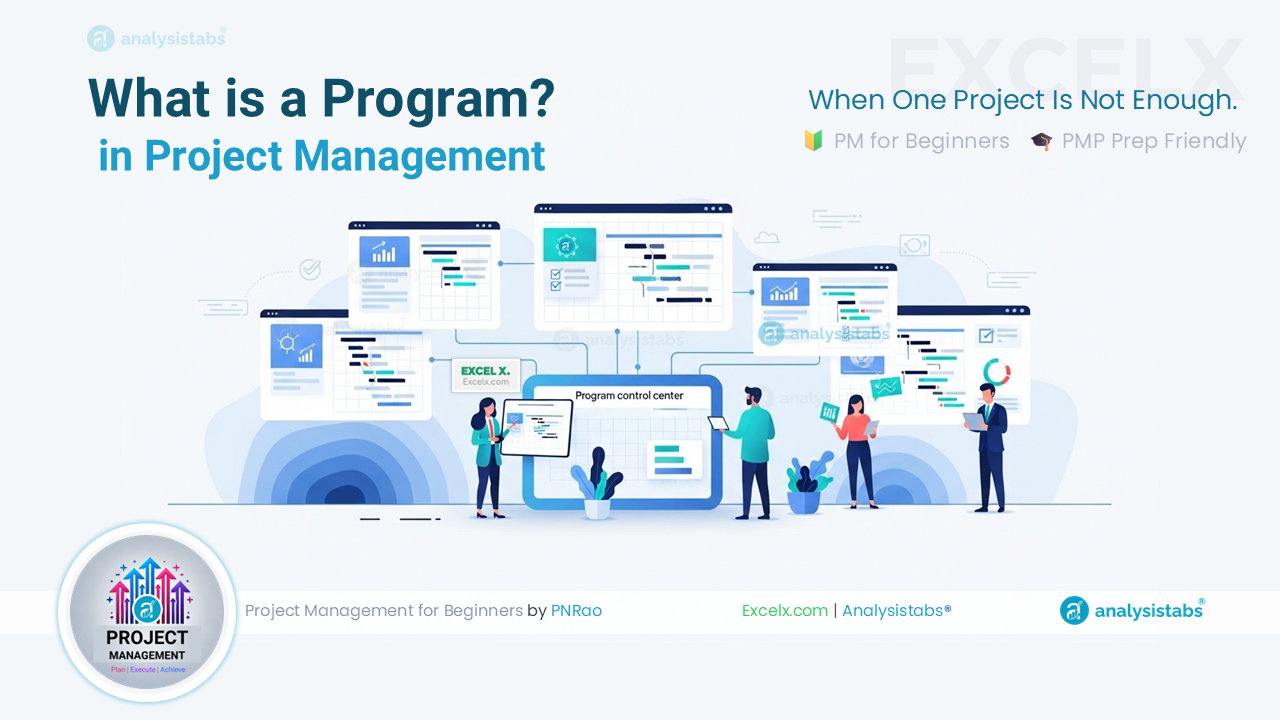
A program in project management is a group of related projects managed together to deliver benefits that no single project could produce independently. Where a project has a fixed end date and a specific deliverable, a program runs until its strategic benefit is fully realized — spanning multiple delivery waves. That difference changes how work is organized, governed, and measured.
In this post, we define exactly what a program is, how it differs from both a project and a portfolio, what a program manager does, and how programs are structured and governed in practice.
What Is a Program in Project Management?
A program exists because the benefit an organization needs cannot be delivered by a single project. It takes multiple related projects, managed together under shared governance, to produce the strategic outcome. The program is the container that holds those projects, coordinates their interdependencies, and focuses on realizing the combined benefit — not just completing individual deliverables.
“A group of related projects, subsidiary programs, and program activities managed in a coordinated manner to obtain benefits and control not available from managing them individually.”
— A Guide to the Project Management Body of Knowledge (PMBOK® Guide), Project Management Institute (PMI)
Program vs Project — Key Differences
The distinction between a program and a project is not one of scale — a large project is still a project. What makes something a program is that its component projects are interdependent and the strategic benefit only emerges from their combined output. The table below maps six key differences that appear on the PMP exam and matter in practice.
| Dimension | Project | Program |
|---|---|---|
| Definition | A temporary endeavour to create a unique product, service, or result | A group of related projects managed together to achieve a shared benefit |
| Focus | Delivering a defined scope on time, within budget, to specification | Realizing a strategic benefit that no single project can deliver alone |
| End date | Fixed — the project closes when the deliverable is complete | Open — runs until the strategic benefit is fully realized |
| Success measure | On time, on budget, in scope — and accepted by the customer | Benefits realized, outcomes achieved, stakeholder value delivered |
| Manager | Project Manager (PM) | Program Manager — focuses on benefits, not tasks |
| Governance | Project sponsor and steering committee | Program board, program PMO, senior responsible owner (SRO) |
| Change | Managed through a formal change management process within scope | Embraced at the strategic level — program scope evolves as the strategy evolves |
Program vs Portfolio — The Three-Level Hierarchy
Programs sit in the middle of the three-level hierarchy that organizations use to manage project work. Understanding where a program fits — above projects but below the portfolio — clarifies who governs it, how its budget is set, and how success is reported to the executive team. The three levels operate at different time horizons with different primary concerns.
A portfolio manager decides which programs and projects to fund. A program manager ensures the funded work is coordinated to produce the intended benefit. A project manager delivers the individual pieces. All three roles are necessary — in large organizations, they are held by three different people reporting upward through the same governance chain.
Real-World Examples of Programs
The clearest way to understand what makes something a program — rather than a large project — is to look at cases where the benefit only emerges from multiple projects delivering together. Each example below shows why independent project management would not have been enough, and what the program-level coordination produced that individual project managers could not.
Digital Transformation Program
A large organization decides to modernize its entire customer-facing operation by running five parallel projects simultaneously — CRM, customer portal, mobile app, data analytics, and staff training. Each has its own PM and budget. However, the benefit — a seamlessly modernized customer experience — only emerges when all five integrate successfully.
A program manager coordinates the interdependencies across all five teams, manages shared data standards and API specifications so that systems connect cleanly at go-live, and stages the delivery sequence to ensure customers are never presented with a partially modernized system where the new portal works but the mobile app still routes calls to the legacy CRM. Without program-level coordination, each project manager would optimize for their own deliverable — and the combined customer experience would be inconsistent, fragmented, and ultimately unable to deliver the strategic benefit the organization invested in.
Network Infrastructure Expansion Program
A telecommunications company wins a government contract to connect 500 rural communities. Each community rollout is its own project — local approvals, site surveys, equipment installation, acceptance testing. Individually, each is straightforward. Together, they share engineering resources, equipment supply chains, and a single national delivery commitment that makes independent management unworkable.
The program manager tracks interdependencies between site approvals, allocates scarce engineering teams across active sites simultaneously, and reports aggregate coverage progress against the national target that the individual project managers cannot see from their own dashboards. When equipment arrives ahead of schedule for one region and is sitting idle, the program manager redirects it to an understaffed site in another region — saving weeks on that site’s timeline. This type of cross-project resource reallocation is the core value a program structure provides that independent project management cannot replicate.
New Product Launch Program
A manufacturing company launching a new product line runs three parallel projects: product development, production line retooling, and market entry. Each has a defined deliverable and could theoretically be managed independently. However, the product launch date is the point where all three must converge — and a delay in any one slips the others.
Managed as a program, the program manager holds the integrated schedule across all three projects, actively manages the buffer between their critical paths, and escalates to the executive sponsor when a delay in production retooling threatens the market entry date that has already been communicated to major retail partners. Without program oversight, the product development team might declare their project complete and begin closing down resources — not realising that the production line will not be ready for another three weeks, leaving finished product inventory with nowhere to go and a market launch date that must be moved publicly.
What Does a Program Manager Do?
A program manager is not a senior project manager. The role operates at a different level — focused on benefits and interdependencies rather than tasks and deliverables. Far more time is spent on stakeholder alignment, governance, and strategic reporting than on schedule management. The project managers inside the program handle execution; the program manager handles the environment that enables it.
Define and Protect the Benefits Case
The program manager owns the benefits realization plan — the document that defines what strategic outcomes the program is expected to produce, how they will be measured, and when they should be visible. This is the single most important difference between program management and project management.
Throughout delivery, the program manager regularly checks whether the work being done is still on track to produce those benefits, and escalates to the program board when scope changes or delays threaten the benefits case rather than just individual project deadlines. A program manager who allows scope to drift because individual project targets are being met is not doing the job — they are confusing output delivery with benefit realization.
Manage Interdependencies Across Projects
Within a program, dependencies between projects are the primary source of schedule risk. A delay in Project A that shifts the start of Project B by two weeks may push the program’s integrated go-live by a month — a connection invisible to either project manager working alone.
The program manager maintains the integrated program schedule, identifies cross-project dependencies that individual project managers cannot see from their own plans, and manages the sequence and timing of deliveries to protect the overall benefit realization timeline. When a dependency conflict arises between two projects whose sponsors disagree on priority, it is the program manager who makes — or escalates — the call.
Manage Shared Resources and Budget
Programs typically operate with a shared resource pool — architects, business analysts, test teams, or infrastructure that multiple projects need simultaneously. The program manager allocates these shared resources across projects, resolving conflicts when two project managers request the same specialist at the same time.
The program manager also manages the overall program budget across all component projects rather than tracking individual project budgets in isolation. This consolidated view enables better trade-off decisions: underspending in one project can fund a contingency need in another without requiring a formal escalation to the program board, keeping delivery moving without governance overhead on every budget movement.
Govern the Program and Manage Stakeholders
Program governance operates at a more senior level than project governance. The program manager chairs the program board, prepares program-level status reports for executive stakeholders, manages the Senior Responsible Owner (SRO) relationship, and escalates decisions too large for individual project sponsors to make unilaterally.
Effective stakeholder management at the program level prevents individual project managers from being pulled in conflicting directions by different business units. Without a program manager holding the governance boundary, each project sponsor tends to optimize for their own deliverable — which can produce outcomes that are individually successful but collectively incoherent. The program manager holds the authority to prioritize the benefit over any individual project’s interests.
Manage Strategic Change Within the Program
Unlike projects, programs are expected to evolve as the organization’s strategy evolves. When market conditions change, regulatory requirements shift, or executive priorities are updated, the program manager assesses the impact on the benefits case and recommends adjustments to scope, sequencing, or investment.
This is called benefits-led change management — adjusting the program to protect the outcome rather than defending the original plan for its own sake. A project manager resists scope change because it threatens their baseline. A program manager embraces strategic change because their success measure is not plan fidelity; it is whether the organization ends up better off as a result of the program. These are fundamentally different orientations to the work.
The Program Lifecycle
A program does not follow the same lifecycle as a project. While a project moves linearly through initiation, planning, execution, and closure, a program cycles through multiple delivery waves — starting and closing individual projects while remaining open to govern the overall outcome. This cycling structure is what anyone moving from project management into program management needs to internalize first.
| Phase | What Happens | Key Output |
|---|---|---|
| Program Definition | The strategic case is made, the program is authorized, the benefits are defined, and the component projects are identified and sequenced | Program mandate, benefits realization plan, program blueprint |
| Program Governance Setup | The program board is established, governance processes are defined, resource pools are secured, and the program office (PMO) is stood up | Program governance framework, roles and responsibilities, program PMO charter |
| Delivery (Tranches) | Projects within the program are initiated, executed, and closed in planned waves (tranches); each tranche delivers a defined portion of the total benefit | Project deliverables, tranche review reports, benefits progress reports |
| Benefits Review | At the end of each tranche and at key milestones, the program board reviews whether expected benefits are materializing and whether the program should continue, adjust, or close | Benefits realization report, updated program business case |
| Program Closure | Once all tranches are complete and benefits are confirmed as realized (or no longer achievable), the program is formally closed and governance structures are disbanded | Final benefits realization report, program closure report, lessons learned |
A national telecoms operator was awarded a government contract to deliver broadband connectivity to 2,000 underserved communities over four years. The initial plan treated each community as a separate project managed by regional delivery teams reporting independently to the client.
By the end of the first year, 180 communities had been connected — ahead of schedule for that region. However, three other regions were significantly behind, and the overall national coverage target was at risk. The problem was not that individual projects were failing; it was that resource conflicts, equipment supply chain priorities, and regulatory approvals were being handled separately by each region without any central coordination. A community in Region 2 was waiting three months for a civil engineering crew that Region 4 had allocated to a lower-priority site.
The decision was made to restructure the work as a formal program. A program manager was appointed to sit above the four regional leads. An integrated program schedule was built for the first time, cross-regional dependencies were mapped, and a shared equipment procurement framework was established. Within six months of the program structure being in place, the overall delivery rate had increased by 40% — not because individual teams were working harder, but because the program manager could see and manage the interactions between them that the regional project managers could not.
5 Common Mistakes in Program Management
Most program failures are caused not by bad technology or insufficient budget, but by structural mistakes in how the program is set up and governed. The five mistakes below consistently appear in post-program reviews across industries — recognizing them before launch is worth more than any recovery plan after delivery has started.
Treating the Program Like a Large Project
The most common mistake is appointing a project manager to run a program and asking them to manage it as a large project. Tracking tasks, chasing deliverables, and maintaining a Gantt chart are project management activities — not program management. A program manager doing those things provides no value beyond what the project managers already provide.
When a program is structurally operated as a project, the individual project managers lose their authority and accountability. Every decision flows upward to the program manager, who becomes a bottleneck. Projects slow down, project managers become disengaged, and the organization ends up with the overhead of a program structure without any of its benefits.
Starting Without a Defined Benefits Realization Plan
A program that cannot articulate its expected benefits before work starts will have no basis for making priority trade-offs during delivery. When two projects compete for the same resource, the program manager needs to know which one contributes more to the program’s benefit — and that determination requires a benefits realization plan with measurable outcomes.
Without it, resource and priority decisions default to whoever has the loudest sponsor, the largest budget, or the nearest deadline. The program drifts toward output delivery and away from benefit realization. By the time the program closes, the projects will be done but the strategic outcome will not have materialized — and the program will have been a structural overhead rather than a value-creating framework.
Under-Resourcing the Program Management Function
Program management is frequently treated as a part-time role. An experienced project manager is asked to run their own project while also “coordinating” two or three other projects that share some dependencies. This is not program management — it is multitasking, and it systematically fails at the point where the program needs most attention.
The integration work — building and maintaining the integrated schedule, mapping and tracking cross-project dependencies, managing shared resources, preparing program board reports, and managing senior stakeholders — is a full-time job on any program with three or more component projects running simultaneously. Under-resourcing the program management function is one of the clearest predictors of a program that will deliver its projects but miss its benefit.
Failing to Review and Update the Benefits Case
Programs run for years. The market conditions, regulatory environment, and organizational strategy that justified the program at launch will have shifted long before all the tranches are complete. A benefits case that is written at program inception and then filed away is not a program management tool — it is a historical document.
Effective program managers review the benefits case at the end of every tranche and whenever a significant change is proposed. They ask: given what we now know about the environment and about what has been delivered so far, does the remaining investment still make sense? Sometimes the honest answer is no. The willingness to recommend closing or restructuring a program that is no longer delivering value is one of the marks of genuinely senior program management capability — and one of the hardest skills to develop in practice.
Confusing Program Closure With Project Completion
A program is not finished when its last project closes — it is finished when the benefit it was designed to produce has been realized and confirmed. These two events can be separated by months or years, particularly in transformation programs where the benefit only becomes measurable after the change has been in operation long enough to produce reliable data.
Closing the program at project completion — before benefits have been measured and confirmed — leaves the organization with no accountability for whether the investment actually delivered. Executives who approved the program funding have no formal mechanism to validate the return. Benefit realization reviews scheduled 6 and 12 months after go-live, with the program manager still accountable, are the mechanism that closes this gap and makes program management a discipline that delivers verified value rather than just structured activity.
🎯 Key Takeaways — The 90-Second Summary