What You’ll Learn in This Post
- The precise definition of a product in project management — official and plain English
- How a product differs from a project, program, and portfolio
- What the product lifecycle is and how it maps to project delivery
- How product management differs from project management — and why both are needed
- What a product manager actually does day to day
- Real-world examples of products across different industries
A product in project management is any deliverable — software, infrastructure, a physical asset, or a service — that continues to exist, generate value, and require management long after the project that created it has closed. The project is temporary; the product is permanent until retired. Understanding this distinction changes how organizations plan, fund, and govern everything they build.
In this post, we define what a product is in a project management context, how it fits into the four-level hierarchy alongside projects, programs, and portfolios, what the product lifecycle looks like, how product management differs from project management, and what a product manager does — and does not do.
What Is a Product in Project Management?
In project management, a product is any output whose useful life extends beyond the project that produced it. A project creates something — software, infrastructure, a physical asset, a service capability — and then closes. The product continues to exist, serve users, and evolve. The project was the mechanism of creation; the product is the ongoing result.
“An artifact that is produced, is quantifiable, and can be either an end item in itself or a component item.”
— A Guide to the Project Management Body of Knowledge (PMBOK® Guide), Project Management Institute (PMI)
A product is anything a project creates that continues to have a life after the project is done. It could be a mobile app, a piece of manufacturing equipment, a financial service, a built facility, or a software platform. What makes it a product — rather than just a deliverable — is that it goes on generating value, incurring costs, and requiring decisions about its future long after the team that built it has moved on.
The PMP exam distinguishes between three types of project outputs: products (quantifiable artifacts with ongoing useful lives), services (capabilities or functions delivered as ongoing activities), and results (outcomes or changes such as documents, research findings, or transformed organizational states). All three can be the output of a project. The distinction matters because products, services, and results are governed, funded, and managed differently after project closure.
Product, Project, Program, and Portfolio — How They Relate
The product sits in a different dimension from the project, program, and portfolio hierarchy. Projects, programs, and portfolios are governance structures for managing work. A product is what that work produces — and it continues to require investment long after those structures are disbanded. This relationship is among the most commonly confused concepts in project management.
| Concept | What It Is | Temporary or Permanent? | Success Measured By |
|---|---|---|---|
| Project | A temporary endeavor to create a unique product, service, or result | Temporary — closes when the deliverable is complete | On time, on budget, in scope, accepted by the customer |
| Program | A group of related projects managed together to achieve a shared strategic benefit | Temporary — closes when the benefit is realized | Strategic benefits realized as planned |
| Portfolio | The complete collection of projects and programs managed to execute organizational strategy | Permanent — evolves continuously with strategy | Strategic alignment and return on investment |
| Product | An artifact created by a project that continues to generate value after project closure | Permanent — until deliberately retired | Value delivered to users; revenue or benefit generated over its lifecycle |
A single product can be created, enhanced, and maintained through multiple successive projects. Version 1.0 of a software platform is delivered by Project A. Version 2.0 is delivered by Project B. A major infrastructure upgrade is delivered by Project C. Each project is temporary and closes. The product — the platform — continues through all of them and outlasts every project that touches it. This is why product management and project management are distinct disciplines that must coexist in any organization that builds things that last.
The PMP exam tests the concept of a project creating a product as part of understanding the project lifecycle versus the product lifecycle. Key distinction: the project lifecycle covers the phases from project initiation to project closure. The product lifecycle spans from the product’s conception through its retirement — and can encompass many project lifecycles as the product is built, enhanced, and eventually decommissioned. A product lifecycle always outlasts the project lifecycle that initiated it.
The Product Lifecycle
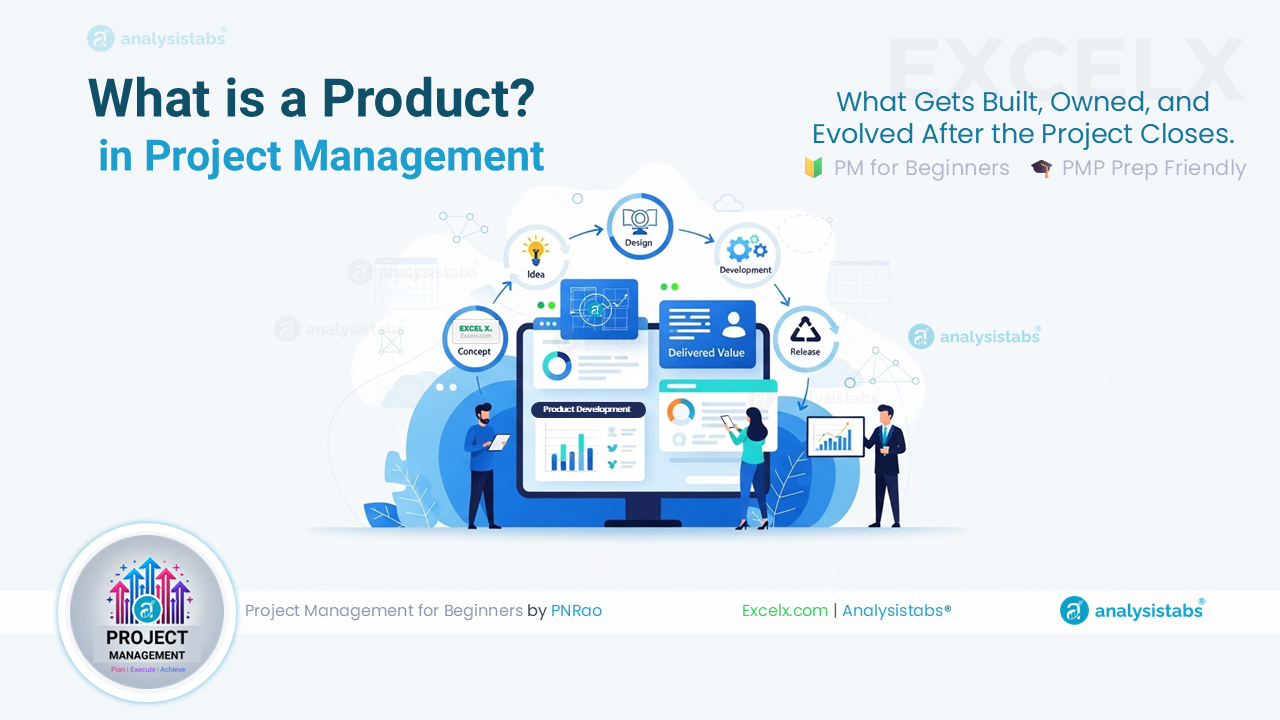
The product lifecycle describes the stages a product passes through from creation to retirement. Understanding it is essential for project managers, because the stage a product occupies directly affects what project work is appropriate and how investment and governance should be calibrated. A product in growth requires fundamentally different investment logic than a product in decline.
| Stage | Description | Typical Project Work | Investment Logic |
|---|---|---|---|
| Introduction / Launch | The product is newly released; user adoption is building and revenue is below cost | Post-launch stabilization projects, early enhancement projects, adoption support | High investment; losses expected; goal is to build user base and prove product-market fit |
| Growth | Adoption is accelerating; revenue is growing rapidly; the product is gaining market share | Capability expansion projects, performance and scalability upgrades, integration projects | High investment; strong returns beginning; priority is to accelerate market share capture |
| Maturity | Growth has plateaued; the product has a stable, established user base; market share is at peak | Optimization projects, cost reduction programs, compliance and security upgrades | Moderate investment; goal is to maximize profitability and extend the maturity phase |
| Decline | Usage or revenue is falling due to competition, technology change, or shifting user needs | Migration projects, decommissioning projects, successor product build projects | Minimal investment; focus is on managing decline and transitioning users to successor products |
| Retirement | The product is formally decommissioned and withdrawn from service | Data migration projects, system decommissioning projects, contract closure | Time-bounded investment; objective is clean, cost-controlled closure |
Project managers working on products at different lifecycle stages face fundamentally different risk and investment environments. A project enhancing a product in decline requires a different approval threshold, risk appetite, and governance approach than a project building a new growth-stage product. Recognizing which lifecycle stage a product is in — and calibrating the project’s scope and investment accordingly — is one of the skills that separates experienced project managers from those who treat all projects identically regardless of the strategic context of the product they are building.
Product Management vs Project Management
Product management and project management are two distinct disciplines that are routinely confused, combined inappropriately, or replaced with each other in organizations that do not understand the difference. Both are essential — but they address fundamentally different questions, operate on different time horizons, and require different skills and authority structures to be effective.
In many technology organizations, project managers are assigned to product development initiatives and asked to “own” the product after delivery. This conflates two different roles. The project manager is skilled at delivering defined scope on schedule; they are not necessarily skilled at — or accountable for — the strategic decisions about what to build next, how to respond to user feedback, or when to retire the product. Organizations that do not separate these roles consistently produce well-delivered products that the market does not want, because no one with authority was asking the product questions during delivery.
What Does a Product Manager Do?
A product manager is accountable for the product’s success from concept through retirement. The role synthesizes user needs, business strategy, and technical feasibility into a roadmap that guides what gets built, when, and why. Unlike a project manager, the product manager’s work does not end at release — it intensifies as post-release data drives the next cycle of decisions.
Define and Maintain the Product Vision and Strategy
The product manager owns the product vision — a clear, stable statement of what the product is trying to achieve for its users and for the business over the long term. This vision provides the reference point against which every feature request, roadmap decision, and investment proposal is evaluated.
Without a clear product vision, teams build features reactively — responding to whoever made the most recent request rather than advancing a coherent product strategy. The product manager’s job is to prevent that by articulating the destination clearly enough that every team member, stakeholder, and project manager working on the product understands what the product is trying to become and can evaluate their work against that standard.
Understand Users and Define Requirements
The product manager is the primary owner of user understanding within the product team. This means conducting user research, analyzing usage data, synthesizing customer feedback, and translating all of that input into prioritized requirements that guide what gets built next.
This is a continuous activity — not something done once at project inception and then filed. User needs evolve, competitive dynamics shift, and usage data from live deployments reveals gaps between what users were assumed to need and what they actually do. The product manager’s job is to ensure that the product evolves in response to that reality, and that project teams building new features are working from validated requirements rather than internal assumptions.
Build and Prioritize the Product Roadmap
The product roadmap is the product manager’s primary planning and communication tool. It shows what the product will deliver, in what sequence, and for what strategic reason — over a planning horizon that typically spans 12 to 24 months.
Building the roadmap requires balancing competing demands from multiple stakeholders — user needs, business requirements, technical debt, regulatory obligations, and market opportunities. Prioritizing the roadmap means making explicit trade-offs between these demands and communicating those trade-offs clearly so that every stakeholder understands why their request is or is not in the next release. The product manager who cannot prioritize with transparency and defensible logic loses the trust of both their users and their engineering teams.
Work With Project and Engineering Teams to Deliver
When roadmap items are approved for delivery, they become projects — and the project manager takes accountability for delivering the defined scope on schedule and within budget. The product manager’s role during delivery is to be available to clarify requirements, make scope trade-off decisions when the project encounters constraints, and accept the delivered output when it meets the product’s standards.
The product manager does not run the project — that is the project manager’s accountability. But the product manager must be engaged enough in delivery to catch requirement misinterpretations early, before they have been built into the product. A product manager who disappears during delivery and only reappears at acceptance testing is one of the most reliable predictors of rework-heavy projects and post-launch product failures.
Measure Product Performance and Drive Improvement
After each release, the product manager measures whether the delivered changes are producing the expected user behavior and business outcomes. This means defining success metrics before release, tracking them post-release, and being willing to act on the data — even when it shows that something that was built is not being used.
This is the discipline that closes the product improvement loop. Without post-release measurement, teams build features into the void and have no way to know whether they are moving toward the product vision or away from it. The product manager who measures systematically, shares results transparently, and updates the roadmap based on what the data shows is the one whose products consistently improve — and whose investment decisions become progressively better calibrated over successive release cycles.
Real-World Examples of Products in Project Management
Products appear in every industry — not just in technology. Understanding what counts as a product, and recognizing the distinction between the project that creates it and the product that persists, helps project managers calibrate their accountability correctly and avoid the common mistake of treating project closure as the end of all responsibility for what was built.
Enterprise Software Platform
A financial services company commissions a three-year project to build a client onboarding platform. The project closes on delivery — scope complete, team disbanded. The platform goes on to serve hundreds of relationship managers, require continuous security patching, compliance updates, and feature enhancements. The project manager’s accountability ended at closure; the product manager’s continues until the platform is decommissioned.
Physical Infrastructure — Manufacturing Equipment
A manufacturer funds a capital project to install an automated assembly line. The project delivers on schedule and closes. The line then operates for a 15-year lifecycle, requiring maintenance, upgrade projects, and eventual decommissioning. Each upgrade is a temporary project; the assembly line as a product is permanent and requires ongoing asset management no project plan covers.
A national retail chain delivered a major e-commerce platform project on time and within budget — celebrated internally as a project management success. The platform launched on schedule, initial transaction volumes met projections, and the project was formally closed three weeks after go-live.
Six months later, the platform was struggling. Conversion rates were 40% below the industry benchmark, mobile performance was poor, and two significant competitors had launched superior checkout experiences in the intervening period. The project had been delivered successfully; the product was failing. The root cause was structural: there was no product manager assigned to own the platform’s performance after project closure. The project manager had moved on to a new assignment. The IT team responsible for maintenance had no mandate or budget to make strategic improvements. The business stakeholders who had sponsored the project considered their involvement complete.
The retail chain eventually assigned a dedicated product manager to the platform, secured an ongoing product investment budget separate from the original project budget, and within 12 months had rebuilt the checkout experience, improved mobile performance, and recovered the conversion rate gap. The lesson drawn internally was not that the project had been poorly managed — it had not been. It was that no one had planned for the product that the project created. Building the product and governing the product are two different organizational commitments, and the organization had only made one of them.
The most common gap in project planning is the absence of a post-project product owner. Before any project that creates a lasting product is approved, two questions must be answered: Who will own this product after the project closes? And what ongoing budget will fund its operation, maintenance, and evolution? Without clear answers to both before the project starts, project success and product success will diverge — and the organization will pay to close that gap later, at far greater cost than prevention would have required.
4 Common Mistakes When Managing Products Through Projects
The mistakes below are not execution failures — they are structural failures in how organizations think about the relationship between the projects they run and the products those projects create. Each one produces a predictable and avoidable failure mode that organizations repeat at significant cost until they build the right governance structures to prevent it.
Treating Project Closure as Product Success
Closing a project on time and on budget is a delivery achievement. It says nothing about whether the product created will generate value over its lifetime. Organizations that celebrate project delivery as the definition of success consistently underinvest in the post-project product management that determines whether the delivered output achieves its purpose.
The correction is to define success metrics for the product — not just the project — before the project begins, and to hold the product against those metrics at 6, 12, and 24 months post-launch. Product metrics (user adoption, revenue contribution, error rates, customer satisfaction) are distinct from project metrics (on-time delivery, budget variance, scope completion) and require a separate measurement and accountability framework that survives project closure.
Building Without a Product Owner
Every project that creates a product needs someone accountable for that product’s ongoing success — someone who owns the requirements, the acceptance criteria, and the post-launch performance targets. When no one is assigned before the project starts, the project team fills the vacuum with their own judgment about what the product should do.
That judgment is not worthless — but it is not a substitute for a product owner who represents actual user needs and organizational strategy. Projects that build without a clear product owner consistently over-engineer technical features that users do not value, under-engineer the user experience dimensions that determine adoption, and leave delivery teams unable to make scope trade-off decisions efficiently when constraints arise mid-project.
Funding the Project Without Funding the Product
Many organizations fund the project to build a product but make no provision for the ongoing investment needed to operate, maintain, and evolve it. The project gets a defined budget and end date. The product — requiring support, security updates, compliance changes, and user-driven enhancements — gets whatever remains in the maintenance budget, typically insufficient and subject to annual cuts.
This structural underfunding of products post-project is one of the most common causes of technical debt accumulation in technology organizations. Products that cannot be adequately maintained degrade in performance and security over time, eventually requiring a major replacement project that costs far more than the steady-state investment would have. The business case for every product-building project should include a post-project operating and enhancement budget as a required deliverable — not an afterthought added during operations planning.
Confusing the Product Roadmap With the Project Plan
A product roadmap and a project plan serve different purposes. The roadmap shows what the product will become over its lifetime — a strategic artifact that evolves as user needs and market conditions change. The project plan shows how a specific roadmap item will be delivered — a tactical document tied to a defined scope, schedule, and budget.
Organizations that use the project plan as their product roadmap end up with a product that only evolves when a project is in flight, with no strategic vision governing what comes next between projects. Organizations that use the product roadmap as their project plan end up with poorly controlled delivery, scope creep, and schedule overruns caused by treating an evolving strategy document as a delivery commitment. Both tools are needed, each for its own purpose, and conflating them produces the failure modes of both.
🎯 Key Takeaways — The 90-Second Summary