
What You’ll Learn in This Post
- The precise definition of a portfolio in project management — official and plain English
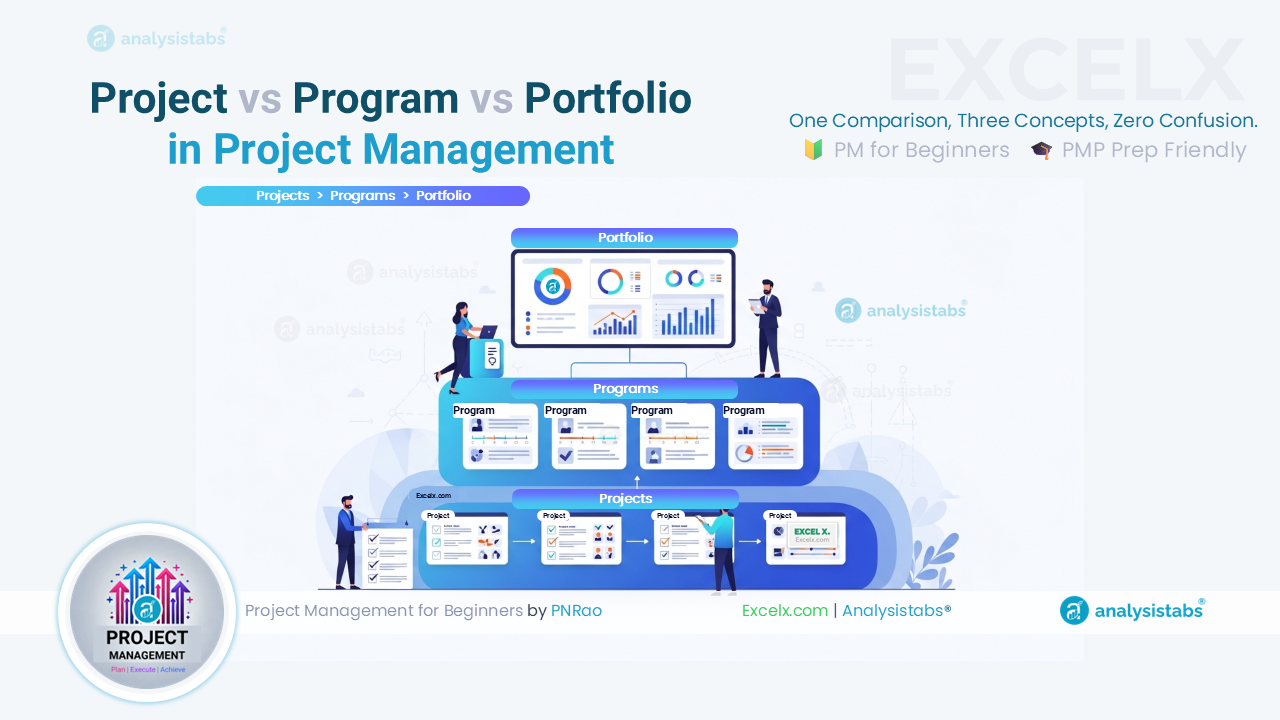
- How a portfolio differs from a program and a project — the full three-level hierarchy
- What portfolio management actually involves day to day
- How portfolio selection decisions are made — and why projects get killed
- The portfolio lifecycle and how it maps to organizational strategy cycles
- Real-world examples of portfolios across different industries
A portfolio in project management is the complete collection of projects, programs, and operations an organization manages to execute its strategy. Where a project delivers a specific output and a program delivers a strategic benefit, a portfolio delivers the organization’s strategy itself — by ensuring the right work is selected, funded, prioritized, and terminated at the right time.
In this post, we define exactly what a portfolio is, how it sits above programs and projects in the governance hierarchy, what a portfolio manager does, how portfolio investment decisions are made, and what portfolio management looks like in practice across different organizational contexts.
What Is a Portfolio in Project Management?
A portfolio exists at the highest level of project governance — above all projects and programs. Its purpose is not to manage work inside individual initiatives, but to ensure the organization invests its finite resources in the right mix of work to achieve its strategic objectives. The portfolio answers: given everything we could do, what should we actually be doing?
“Projects, programs, subsidiary portfolios, and operations managed as a group to achieve strategic objectives.”
— A Guide to the Project Management Body of Knowledge (PMBOK® Guide), Project Management Institute (PMI)
A portfolio is the organization’s total investment in change — every project, every program, and every ongoing initiative running simultaneously. It is managed not to deliver any single output or benefit, but to ensure that the whole collection of work is aligned with strategy, properly resourced, and delivering maximum value relative to the investment being made. Portfolio management is fundamentally about choosing what to do and what to stop — not about how to do it.
The PMP exam tests the portfolio concept in the context of organizational strategy and governance. Key facts to know: portfolio components do not need to be related to each other — unlike programs, where projects must share a strategic benefit. A portfolio can contain projects, programs, subsidiary portfolios, and operations. Portfolio management success is measured by strategic alignment and value maximization, not by whether individual projects are delivered on time and on budget.
The Three-Level Hierarchy — Portfolio, Program, Project
The portfolio sits at the top of the three-level hierarchy that organizations use to govern project work. Understanding what each level is responsible for — and explicitly not responsible for — is the foundational concept in organizational project management. The hierarchy clarifies three accountability questions: who decides what gets done, who ensures outcomes are achieved, and who delivers individual scope.
Portfolio components do not need to be related to each other. A portfolio can contain a cost-reduction program, a new product development project, an infrastructure upgrade, and a compliance initiative simultaneously — all unrelated in content, but all competing for the same finite pool of organizational resources. It is this competition for resources, and the need to prioritize rationally across unrelated investments, that makes portfolio management a distinct discipline.
The exam frequently tests all three levels together in scenario questions. The signal words to look for: portfolio = strategic selection, prioritization, and investment decisions; program = benefits realization and interdependency coordination; project = scope delivery, schedule, and cost control. A question describing a C-suite decision about which initiatives to fund next year is describing portfolio management — even if it does not use the word “portfolio.”
What Does a Portfolio Manager Do?
A portfolio manager is not a program manager with a larger remit. The role sits at the intersection of strategy and execution — translating organizational objectives into investment decisions and ensuring the portfolio stays aligned as strategy evolves. Most time is spent on governance, financial management, and senior leadership communication rather than on delivery management.
Translate Strategy Into Investment Decisions
The portfolio manager works with executive leadership to understand the organization’s strategic objectives and translate them into a prioritized investment portfolio. This means evaluating proposed projects and programs against strategic criteria — not just financial return — and making or recommending decisions about which initiatives to fund, delay, or decline.
This is the most consequential part of the role. A well-constructed portfolio is one where every component can be traced directly to a strategic objective. A poorly constructed one is a collection of projects that have survived internal politics rather than strategic evaluation — and will consume resources without producing proportionate strategic value. The portfolio manager’s job is to make that distinction systematically and defend it under organizational pressure.
Balance the Portfolio Across Risk, Time, and Investment Type
A well-managed portfolio is not simply a list of the highest-scoring individual projects. It is a balanced mix of work that manages risk at the portfolio level — across short- and long-term horizons, across mandatory and discretionary investment, and across high-risk/high-return initiatives and lower-risk/steady-return ones.
Portfolio balancing is one of the activities that most distinguishes portfolio management from project and program management. A portfolio manager might recommend funding a lower-scoring project because the portfolio already has too much exposure to a particular technology risk, or because the organization needs near-term wins to maintain stakeholder confidence in the overall change program. These are portfolio-level judgments that no individual project sponsor can make, because they require visibility across the entire investment landscape simultaneously.
Manage Capacity and Resource Allocation Across the Portfolio
One of the most common causes of portfolio failure is funding too many projects relative to the organization’s actual delivery capacity. When a portfolio is overloaded, all projects slow down as teams are stretched across too many simultaneous demands — producing a situation where everything is in progress but nothing is completing.
The portfolio manager maintains a portfolio capacity model — tracking the demand that approved projects place on scarce shared resources (architects, senior developers, change managers, test teams) against the actual supply of those resources. When the demand exceeds capacity, the portfolio manager recommends which projects to defer rather than letting all projects degrade simultaneously. This is called active capacity management, and it is one of the highest-value activities a portfolio manager can perform for organizational delivery throughput.
Monitor Portfolio Performance and Alignment
Portfolio performance reporting operates at a different level than project or program reporting. The portfolio manager is not monitoring whether individual tasks are on schedule — that is the project manager’s responsibility. Instead, the portfolio manager monitors whether the portfolio as a whole is delivering strategic value at the expected pace and cost.
At a minimum, portfolio performance monitoring covers: aggregate investment versus approved budget across all components; benefits realization progress across programs; strategic alignment reviews (are the projects we are running still aligned to the strategy we are executing?); and portfolio health indicators (what proportion of components are Green/Amber/Red, and what does the trend line look like?). This information is synthesized into portfolio-level reporting for the board, C-suite, or investment committee — not delivered project by project.
Make and Recommend Termination Decisions
Terminating a project or program that is no longer strategically viable is one of the most important — and most consistently avoided — portfolio management responsibilities. Organizations are systematically biased toward continuing work they have already invested in, even when the investment case no longer holds.
The portfolio manager is the role that should provide the governance mechanism and the data to overcome this bias. When a project’s strategic context has changed, when a benefits case has been invalidated by market conditions, or when continued investment would divert resources from higher-priority work, the portfolio manager makes the termination recommendation and owns the process of closing the initiative cleanly — including redeploying resources and capturing lessons learned for future investment decisions.
How Portfolio Selection Decisions Are Made
Portfolio selection is how an organization decides which projects and programs to fund from competing proposals. Most organizations do this badly — funding initiatives based on who proposed them or how loudly the request was made. Effective portfolio management replaces those informal dynamics with a structured evaluation process that produces defensible, strategy-aligned decisions.
The Portfolio Scoring Model
Most mature portfolio management functions use a weighted scoring model to evaluate proposed initiatives against a consistent set of criteria. Each proposed project or program is scored on dimensions that reflect the organization’s strategic priorities — and the scores determine priority for funding and resource allocation.
| Evaluation Criterion | What It Measures | Typical Weight |
|---|---|---|
| Strategic alignment | How directly does this initiative advance one or more of the organization’s stated strategic objectives? | 30–40% |
| Financial return | Expected NPV, ROI, or payback period relative to the investment required | 20–30% |
| Risk level | Delivery risk, dependency risk, and strategic risk if the initiative fails to deliver | 15–25% |
| Mandatory / compliance | Is the initiative required by regulation, contract, or legal obligation? | Binary — mandatory initiatives are typically funded first regardless of score |
| Capacity fit | Can the organization actually deliver this at the proposed time without overloading shared resources? | Threshold — projects that fail capacity checks are deferred regardless of score |
| Strategic urgency | Does the value of this initiative decay significantly if it is delayed? | 10–15% |
The Investment Review Cycle
Portfolio investment decisions are not made once and then left alone. Organizations that manage their portfolios effectively run a regular investment review cycle — typically quarterly — at which proposals are evaluated, running initiatives are reviewed for continued viability, and the portfolio composition is adjusted to reflect changes in strategy, market conditions, and delivery performance.
| Review Type | Frequency | Key Decisions |
|---|---|---|
| Annual Portfolio Plan | Annually (aligned to budget cycle) | Set overall portfolio investment envelope; approve major programs for the year; retire completed initiatives |
| Quarterly Investment Review | Every quarter | Approve new projects; review running portfolio performance; adjust priorities; defer or terminate underperforming initiatives |
| Monthly Portfolio Health Check | Monthly | Review aggregate RAG status; flag capacity constraints; escalate cross-portfolio dependency conflicts |
| Ad-hoc Strategic Change Review | As required | Respond to significant strategic shifts (M&A activity, regulatory change, market disruption) that require immediate portfolio rebalancing |
Organizations that approve every project with a positive business case — without regard to capacity, strategic priority, or portfolio balance — invariably end up with overloaded portfolios where delivery velocity collapses. Every project competes for the same engineers, architects, and change managers. All projects slow down. None complete on schedule. The cost of this throughput degradation is typically far larger than the value of the additional projects that were approved but should have been deferred.
Real-World Examples of Portfolio Management
The clearest way to understand portfolio management is through cases where the portfolio-level decision — not the project or program decision — determined whether the organization succeeded or failed. Each example below shows what a portfolio manager was responsible for that no project or program manager could have handled from their position in the hierarchy.
Technology Investment Portfolio — Financial Services
A regional bank’s technology division runs 47 simultaneous projects and programs — core banking modernization, regulatory compliance, digital channel upgrades, and internal efficiency initiatives. None are related to each other; all are funded from separate budgets and managed by separate teams. What they share is competition for the same pool of senior engineers, enterprise architects, and business analysts.
Without portfolio management, each program manager advocates for their own initiative’s resource needs — and the most politically influential sponsors get first access to the best people. The portfolio manager’s role is to replace that dynamic with a structured capacity allocation process. Every quarter, the portfolio manager produces a capacity demand map that shows the total demand on each scarce resource category from all 47 concurrent initiatives, compares it to available supply, and recommends which projects to defer to the next quarter to bring demand into line with capacity. This single activity — done well — is the difference between a technology division that delivers 12 major initiatives per year and one that starts 20 but completes 6.
Product Development Portfolio — Consumer Goods Manufacturing
A consumer goods manufacturer maintains a product development portfolio of 35 new product concepts at various stages of development — from early feasibility through final launch preparation. At any point, only 8–10 can receive full development investment; the rest are either in a holding pool or must be terminated to free up production line testing capacity.
The portfolio manager runs a quarterly gate review process where each concept is reassessed against current market data, updated financial projections, and competitive intelligence. Concepts that no longer meet the portfolio’s financial return thresholds or that have been superseded by a competitor launch are terminated — even if significant development investment has already been made. This willingness to act on sunk cost irrationality is one of the hardest portfolio management disciplines to institutionalize, and the organizations that do it consistently outperform those that protect failing projects because “we’ve already spent the money.”
A mid-sized industrial manufacturer operated a capital investment committee that met annually to approve the following year’s project portfolio. In practice, the committee approved every project with a positive NPV and a sponsor willing to present it. By mid-year, the portfolio contained 34 simultaneous capital projects sharing 8 project managers and a single procurement team.
Delivery performance was poor — only 11 of 34 projects completed on schedule, and average cost overrun was 28%. The operations director commissioned a portfolio review, which found that the primary cause of overruns was not poor project management. It was that every project was drawing on the same procurement team for equipment orders, creating a sequencing backlog that pushed every project’s critical path out by 6–14 weeks regardless of how well the project itself was being managed.
The following year, the investment committee adopted a portfolio capacity constraint. No more than 18 capital projects could be active simultaneously. Projects were scored and sequenced, and the 16 lowest-scoring initiatives were deferred to the following year. With 18 active projects sharing the same procurement team, delivery performance improved to 15 of 18 projects completing on schedule — and the average cost overrun dropped to 6%. The total capital delivered in that year was actually higher than the previous year, despite approving fewer projects, because projects that started completed rather than stalling at procurement bottlenecks.
The Portfolio Lifecycle
Unlike projects and programs, a portfolio has no defined start or end date — it is a permanent governance structure that evolves as strategy changes and components are added, completed, or terminated. The portfolio lifecycle is best understood as recurring management cycles rather than a linear phase sequence, each governing a specific aspect of portfolio health.
| Cycle | What It Governs | Key Output |
|---|---|---|
| Strategic Alignment | Ensuring the portfolio composition reflects current organizational strategy — not last year’s strategy or the strategy that produced last year’s approved projects | Portfolio strategic alignment report; recommended additions and terminations |
| Demand Management | Capturing and evaluating proposed new initiatives against portfolio scoring criteria before they are approved and resourced | Prioritized pipeline of approved, pending, and deferred initiatives |
| Capacity Planning | Matching the resource demand of the approved portfolio against actual organizational delivery capacity, and sequencing work to prevent overload | Portfolio capacity model; deferred project list; resource allocation recommendations |
| Performance Monitoring | Tracking aggregate delivery performance, benefits realization progress, and strategic value delivered across all portfolio components | Portfolio dashboard; escalation recommendations; investment adjustment proposals |
| Benefits Realization | Confirming that completed programs and projects are delivering the benefits that justified their investment — and feeding results back into future investment scoring models | Portfolio benefits realization report; lessons learned for investment model calibration |
One of the defining characteristics of portfolio management is that it is a continuous, recurring governance activity — not a project that completes and closes. As long as the organization is investing in change, there is a portfolio to manage. The moment an organization stops actively managing its portfolio — reviewing priorities, enforcing capacity limits, and terminating non-performing initiatives — the portfolio becomes a backlog of approvals that have accumulated without strategic logic, and delivery performance degrades accordingly.
5 Common Portfolio Management Mistakes
Most portfolio failures are caused not by poor technique but by organizations that have not committed to genuine portfolio management at all. The five patterns below are the most common ways organizations create the structure of portfolio management without producing its benefits — and each one consistently produces the same failure modes in delivery and strategic alignment.
Approving Every Project That Has a Positive Business Case
A positive business case is a necessary condition for funding — not a sufficient one. Every approved project draws on the same finite pool of people and change capacity. Approving all viable projects without regard to capacity systematically overloads delivery and ends up producing less total value than funding fewer projects and completing them faster.
Effective portfolio management requires the discipline to defer high-quality projects specifically because funding them now would degrade the performance of the work already in flight. This is counterintuitive and organizationally difficult — but it is the discipline that separates high-performing delivery organizations from ones that are perpetually behind on everything.
Treating Portfolio Management as a Planning Exercise Rather Than a Governance Function
Many organizations run an annual portfolio planning exercise — scoring projects, building priority lists, producing a plan — and then make no further portfolio-level decisions for the rest of the year. This is planning, not management. A portfolio plan produced in January that has not been reviewed in July is a historical snapshot, not a live governance tool.
Portfolio management requires the authority and the process to make active investment decisions throughout the year — approving new work when capacity opens up, deferring or terminating work when priorities change, and rebalancing the portfolio in response to delivery performance and strategic shifts. Without that ongoing governance authority, the portfolio plan is a document rather than a management tool.
Confusing Portfolio Reporting With Portfolio Management
A monthly dashboard showing the RAG status of every project is a reporting activity — not a management one. Portfolio reporting only adds value if it triggers decisions. When the dashboard consistently shows 40% Amber or Red and no investment decisions follow — no deferrals, no terminations, no reallocations — it is generating insight that no one is acting on.
The test of whether an organization is genuinely managing its portfolio is not whether it produces portfolio reports. It is whether those reports result in portfolio-level decisions, and whether those decisions change the composition, sequencing, or resourcing of the work in flight. Reporting without authority to act is an administrative overhead, not a governance function.
Allowing Projects to Be Approved Outside the Portfolio Process
In most organizations, there is a formal portfolio approval process for large initiatives — and an informal route by which smaller projects get started without going through it. Over time, the informal route becomes the default for anyone who wants to avoid scrutiny, and the portfolio management process only sees the projects that sponsors are willing to have evaluated.
This creates a two-tier system where the portfolio manager has visibility of perhaps 60% of the organization’s actual project activity — and is therefore making capacity and priority decisions based on incomplete information. The result is that portfolio-approved projects compete for resources with a shadow portfolio of informally approved work that the portfolio management function cannot see, cannot manage, and cannot defer. Closing this gap requires executive commitment to a single intake process with no informal bypass routes.
Measuring Portfolio Success by Project Delivery Metrics
A portfolio that delivers 90% of its projects on time and on budget, but whose projects are not advancing the organization’s strategic objectives, is a high-performing delivery machine pointed in the wrong direction. Portfolio success is not measured by project delivery metrics — it is measured by strategic outcomes and return on portfolio investment.
Organizations that evaluate their portfolio management function by delivery KPIs inadvertently incentivize project managers to select safe, easily deliverable projects over strategically important ones. The portfolio manager should be measured on strategic value delivered and benefits realized relative to investment — metrics that require a 12–24 month measurement horizon rather than the quarterly delivery snapshots that project reporting typically produces.
🎯 Key Takeaways — The 90-Second Summary
Share This Story, Choose Your Platform!
80+ PREMIUM
Budget, Finance,
Calendars & Life
Planner Templates
→ Get Premium Templates
Take Control of Your Finances
Interactive dashboards, auto-calculations & visual breakdowns — starting from just $9.