
What You’ll Learn in This Post
- Why project success means far more than on time, on budget, and on scope
- The 5 dimensions of project success — and why most projects only measure the first three
- The critical difference between project success and product success — and why confusing them causes real harm
- How to define success criteria before planning begins — the step most teams skip
- Leading and lagging indicators for measuring whether a project truly succeeded
- Real-world examples of technical success paired with business failure — and what separates projects that deliver lasting value
Project success is one of the most widely used and least precisely defined concepts in project management. Ask ten project managers what it means and you will get ten different answers — on time and on budget, stakeholder satisfaction, benefits realized, team morale, client renewal rate. All of them are partially right. None of them alone is sufficient. Indeed, the real answer is that project success is multi-dimensional, and the dimensions that matter most are often the ones that receive the least attention during planning.
Specifically, in this post we challenge the traditional triple-constraint definition of project success, introduce the five-dimension framework that better reflects how value is actually created and sustained, explain how to define success criteria before a project begins, and examine what the evidence tells us about why projects that look successful at go-live sometimes fail to deliver lasting value — and vice versa.
What Is Project Success?
Project success is the degree to which a project achieves its intended outcomes — for the organization that commissioned it, the people who will use its deliverables, and the stakeholders who have a stake in its results. At its narrowest, project success is defined by the triple constraint: the project delivered the agreed scope, within the agreed budget, by the agreed deadline. At its broadest, however, project success means the project created lasting value that justified the investment made to produce it.
“Project success should be measured in terms of completing the project within the constraints of scope, time, cost, quality, resources, and risk as approved by the project sponsors and stakeholders.”
— A Guide to the Project Management Body of Knowledge (PMBOK® Guide), Project Management Institute (PMI)
The official definition is a good starting point — but in practice, it misses the most important question: did the project actually deliver the value it was funded to create? A project that ships on time, on budget, and on scope, but whose deliverable is abandoned within 90 days because users rejected it, has technically succeeded and practically failed. Real project success means the right thing was built, delivered correctly, adopted by users, and used to generate the outcomes that justified the original business case.
The PMP exam tests project success primarily through the lens of stakeholder satisfaction and benefits realization, not just the triple constraint. A common exam scenario presents a project delivered on time and on budget but with key stakeholders dissatisfied — and asks whether the project was successful. The correct PMI position: stakeholder satisfaction is a required component of project success, not an optional bonus. A project that meets the iron triangle but leaves key stakeholders dissatisfied is not considered fully successful in the PMBOK framework.
The 5 Dimensions of Project Success
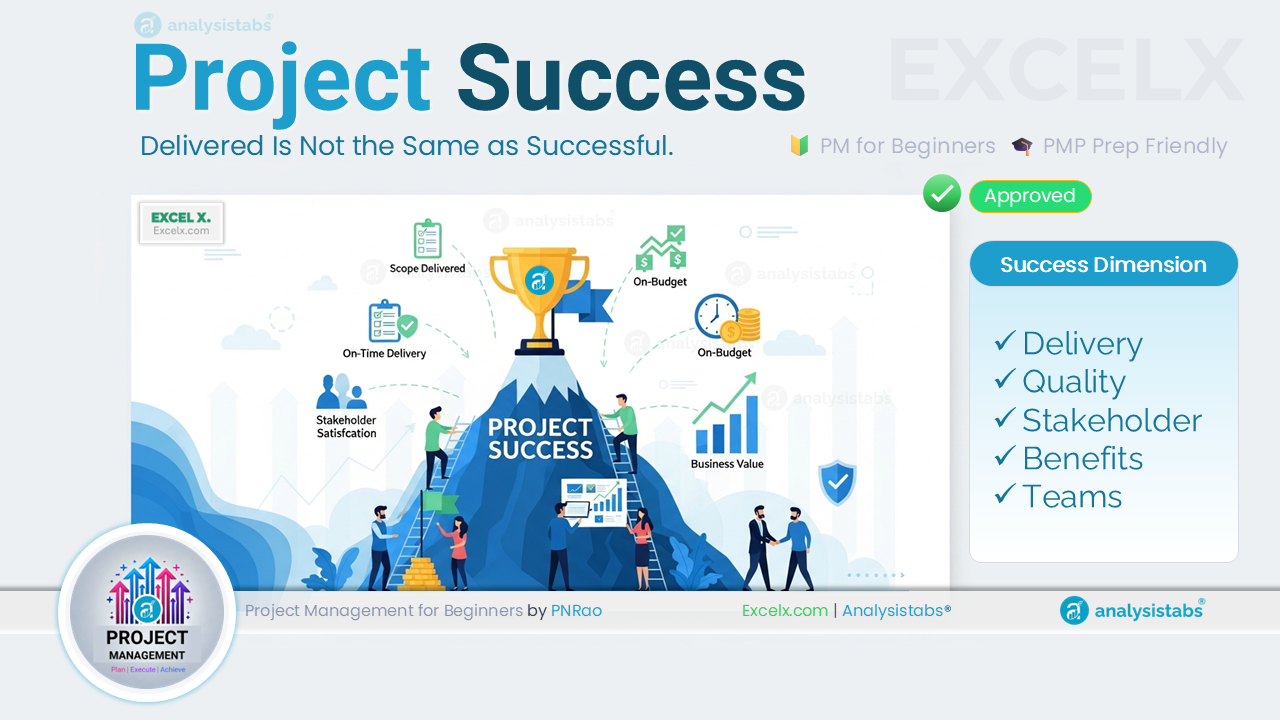
The most useful framework for understanding project success treats it as five distinct dimensions — each necessary, none sufficient on its own. Measuring only the first three dimensions, as most project teams do, provides an incomplete and often misleading picture of whether a project has actually created value. Consequently, organizations that evaluate project success on delivery metrics alone consistently overestimate their performance and underinvest in the dimensions that drive lasting outcomes.
Delivery Success — On Time, On Budget, On Scope
Delivery success is the traditional triple-constraint measure: did the project deliver what was agreed, within the time and budget that were authorized? This dimension is the most visible, the most measurable, and the most commonly reported to sponsors and steering committees. However, it is also the most misleading when treated in isolation — because a project can achieve perfect delivery success while failing on every other dimension. Delivery success is necessary but not sufficient for genuine project success.
Quality Success — The Deliverable Works as Required
Quality success means the deliverable functions as specified and meets the acceptance criteria agreed with the customer or end user. A system delivered on time that crashes under normal load, a building handed over with 40 defects on the punch list, or a process redesign that introduces more errors than it removes — all represent delivery success paired with quality failure. Consequently, quality success requires that the project team has built and executed a testing and acceptance process rigorous enough to surface defects before the deliverable reaches the user, not after.
Stakeholder Success — Key Stakeholders Are Satisfied
Stakeholder success means that the people who matter most to the project — the sponsor, the business owner, the end users, and affected third parties — feel that the project met their expectations and treated their interests with appropriate respect. Importantly, stakeholder success is not the same as making everyone happy with every decision; it means that stakeholders felt heard, were kept appropriately informed, understood the trade-offs made on their behalf, and accepted the outcome even where it involved compromises. A project that achieved its technical objectives while alienating its key stakeholders has created future delivery risk — because those same stakeholders are the people whose support the next project will need.
Benefits Success — The Business Case Is Realized
Benefits success is the dimension that most directly answers the question of why the project was funded in the first place. Did the new system reduce processing time as projected? Was the revenue forecast in the business case actually achieved? Did the process redesign reduce error rates as specified? These outcomes are typically measured 3–12 months after project closure — which is exactly why they are so rarely measured at all. Projects close, teams disband, and the business case assumptions are never tested against actual outcomes. Without benefits measurement, there is no way to know whether the investment was justified — or to improve estimating accuracy on future business cases.
Team Success — The Project Team Remained Healthy and Capable
Team success is the dimension most consistently overlooked in formal project success evaluations — and most consistently felt by the people who experienced the project. Did the team learn new skills? Were team members treated with respect? Did the project leave key contributors burned out, resentful, or reluctant to work on similar projects again? A project delivered on time through sustained 70-hour weeks, chronic under-resourcing, and a blame culture may meet the first four dimensions while systematically damaging the organization’s most valuable delivery asset: its people. Moreover, team success is a leading indicator of future project success — organizations whose people enjoy and grow through project work consistently outperform those whose teams merely survive it.
Project Success vs. Product Success — A Distinction That Changes Everything
One of the most important and least-discussed distinctions in project management is the difference between project success and product success. A project can be perfectly successful — on time, on budget, on scope, stakeholders satisfied, team healthy — while the product or service it delivered fails completely to achieve its intended purpose. Conversely, a project that was difficult, expensive, and contentious can deliver a product that transforms an organization. Understanding this distinction changes how project success is defined, measured, and rewarded.
The most common project success failure pattern is the “go-live trap” — the tendency to declare project success at the moment of deployment, before any evidence of business outcomes exists. Go-live is a delivery milestone, not a success milestone. True project success can only be assessed after the deliverable has been in use long enough to produce measurable results — which is rarely the case on the day the project closes. Therefore, organizations that only measure success at go-live systematically overestimate their project performance and underinvest in post-delivery adoption and benefits realization.
How to Define Project Success Criteria Before Planning Begins
The single most effective way to improve project success rates is to define what success means — specifically and measurably — before the project plan is written. Success criteria defined after the fact are not criteria; they are rationalizations. Defining success up front creates a shared contract between the project team and the sponsor, eliminates ambiguity about what the project is trying to achieve, and provides the measurement baseline against which project outcomes can be honestly assessed.
Define Delivery Success Criteria in the Project Charter
Every project charter should contain explicit, measurable success criteria for the delivery dimension: the scope that must be delivered, the schedule milestones that constitute on-time delivery, and the budget tolerance within which the project is considered on track. These criteria should be specific enough to be unambiguous — “the system goes live by March 31” is a criterion; “the project completes on time” is not. Furthermore, delivery success criteria should include quality thresholds: defect rates, test pass rates, performance benchmarks, or acceptance criteria that define what “done” means beyond the simple fact of deployment. Download our free Project Charter Template to capture all success criteria in a single agreed document before planning begins.
Define Stakeholder Success Criteria Through Conversation
Stakeholder success criteria cannot be written by the project manager in isolation — they must be elicited through structured conversations with each key stakeholder group. These conversations should uncover what each stakeholder most needs from the project, what would constitute an unacceptable outcome, and what trade-offs they are willing to accept between the competing constraints. Additionally, stakeholder expectations that are left implicit — assumed rather than stated — are the most reliable source of stakeholder dissatisfaction at project closure, because each party discovers at the end that the other was working toward a different definition of success.
Define Benefits Success Criteria in the Business Case
Benefits success criteria must be defined in the business case, not the project plan — because they describe what the investment is expected to return, not what the project is expected to deliver. Specifically, each benefit must be expressed as a measurable outcome with a target value, a baseline measurement, a measurement method, and a review date. For example, “The new system will reduce customer service call handling time by 25% within 6 months of go-live, measured against a baseline of 8.2 minutes per call from Q3 data” is a benefits criterion. By contrast, “The project will improve customer service efficiency” is not.
Assign a Benefits Owner Before the Project Closes
Every measurable benefit must have a named business owner — a person in the operational organization, not on the project team — who is responsible for tracking and reporting actual benefit delivery against the targets defined in the business case. This assignment must happen before the project closes and the team disbands, not during the post-project review when the PM is already engaged on the next assignment. Without a named benefits owner, there is no accountability mechanism to ensure the investment is actually returned — and no organizational memory of what the project was supposed to achieve.
How to Measure Project Success — Leading and Lagging Indicators
Measuring project success requires a combination of leading indicators — metrics available during the project that predict whether it is on track to succeed — and lagging indicators — outcomes measured after the project closes that confirm whether it actually did. Most project teams measure only lagging indicators, and even then, only the easiest ones: final budget vs. approved budget, actual end date vs. planned end date. However, this narrow measurement approach misses the dimensions — quality, stakeholder satisfaction, benefits, and team health — that determine whether the investment actually paid off.
| Success Dimension | Leading Indicators (During Project) | Lagging Indicators (Post-Project) |
|---|---|---|
| Delivery | Schedule variance, cost variance, earned value, milestone completion rate | Final schedule overrun (days), final budget variance ($), scope completion % |
| Quality | Defect discovery rate in testing, rework rate, test pass rate by sprint | Post-go-live defect rate, severity of production incidents, time-to-resolution |
| Stakeholder | Stakeholder engagement scores, approval turnaround time, attendance at key reviews | End-of-project stakeholder satisfaction survey, sponsor NPS, likelihood to recommend |
| Benefits | Adoption readiness, training completion rate, user acceptance testing results | Benefits realization vs. business case at 30, 90, 180 days post-go-live |
| Team | Team engagement pulse scores, overtime hours, staff turnover during project | Team retrospective scores, willingness to work on similar projects, post-project burnout rate |
After 20 years of delivering projects across industries, the clearest signal I have found that a project will succeed is not the schedule or the budget — it is whether the business owner can answer two questions clearly at the end of Week 2: “What specific outcome will this project produce for your team?” and “How will you know, six months after go-live, whether it worked?” If the business owner cannot answer both questions concisely and consistently, the project does not yet have a real definition of success. No amount of delivery excellence can compensate for a project that was built around a vague or untested assumption about the value it was supposed to create. Fix the success definition before you fix the plan.
Project Success Examples — What the Pattern Looks Like Across Industries
Project success and project failure rarely look the way we expect them to. The most instructive examples are those where the delivery outcome and the business outcome diverge — because they reveal the specific dimension of success that was missing and how earlier attention to that dimension could have changed the result.
| Industry | Project Type | Delivery Outcome | Business Outcome | Missing Dimension |
|---|---|---|---|---|
| 💻 IT / Software | CRM implementation | On time, on budget, all modules deployed | 18% user adoption at 90 days. Sales team continued using spreadsheets. Business case ROI not achieved. | Benefits and Stakeholder — users never consulted during design; no adoption plan |
| 🏗️ Construction | Office headquarters redesign | 3 weeks over schedule, 8% over budget due to late client design changes | Staff satisfaction scores increased 34%. Collaboration metrics improved significantly. Client renewed the facilities management contract. | Delivery — but the project succeeded on every other dimension |
| 🏦 Banking | Digital onboarding platform | On time, on budget, fully tested | Customer drop-off rate during digital onboarding fell from 41% to 12% within 60 days. Benefits realization exceeded the business case by 22%. | None — succeeded on all five dimensions |
| 🏥 Healthcare | Patient scheduling system replacement | On scope, 6 weeks over schedule due to integration complexity | No-show rate reduced by 28%. Staff overtime reduced by 15%. Patient satisfaction improved. CFO declared the project a clear success despite schedule slip. | Delivery (schedule) — but benefits realization justified the overrun |
| 🏪 Retail | Loyalty program relaunch | Delivered on time and on budget with all features complete | Loyalty program enrollment declined 11% in the first quarter post-launch. Customer research revealed the redesigned points system was considered less valuable than the previous version. | Benefits and Quality — the product was technically correct but commercially wrong |
On a large-scale ERP implementation for a US-based manufacturing company, the project delivered every module on time, within 2% of the approved $4.2 million budget, and passed all formal acceptance tests. The project manager presented a closing report declaring full project success at the go-live celebration in Week 28. Six months later, however, a post-implementation review told a different story: adoption in the production planning department — the primary beneficiary of the new system — was 23%. The department head had quietly instructed his team to continue using the legacy spreadsheet process in parallel, citing the ERP’s production planning module as “too rigid for real-world scheduling.” As a result, the legacy spreadsheets were being manually reconciled with the ERP daily, consuming 11 hours of analyst time per week that had not existed before the project.
A root cause analysis found that the production planning team had been excluded from the requirements workshops in Weeks 2 and 3, because the project sponsor had determined that their schedules could not accommodate a full-day session. As a result, the module had been configured to match the process described in a process document that was two years out of date. The technical implementation was flawless — however, the business outcome was decisively negative. Rather than eliminating work, the project had created it, and the corrective action required a $280,000 reconfiguration engagement that the business case had never anticipated, because nobody had measured adoption as a success criterion or assigned a benefits owner before the project closed.
The Key Factors That Drive Project Success
Research into project success consistently identifies the same cluster of factors that separate high-performing projects from average ones. These factors are not about tools or methodologies — they are about behaviors, disciplines, and decisions made in the first weeks of the project when they are cheapest to get right. Notably, none of these factors require a larger budget or a more experienced team; they require discipline and deliberate setup before the execution pressure begins.
🎯 Key Takeaways — The 90-Second Summary
Share This Story, Choose Your Platform!

80+ PREMIUM
Budget, Finance,
Calendars & Life
Planner Templates
→ Get Premium Templates
Take Control of Your Finances
Interactive dashboards, auto-calculations & visual breakdowns — starting from just $9.