
What You’ll Learn in This Post
- The precise definition of project risk — including the often-overlooked positive risk
- The 7 categories of project risk every PM needs to know and watch for
- How to build and maintain a risk register that actually gets used
- The 4 risk response strategies — avoid, transfer, mitigate, accept — with real examples
- Project risk examples across IT, construction, healthcare, banking, and retail
- A practical risk management framework for identifying, assessing, and controlling risk throughout delivery
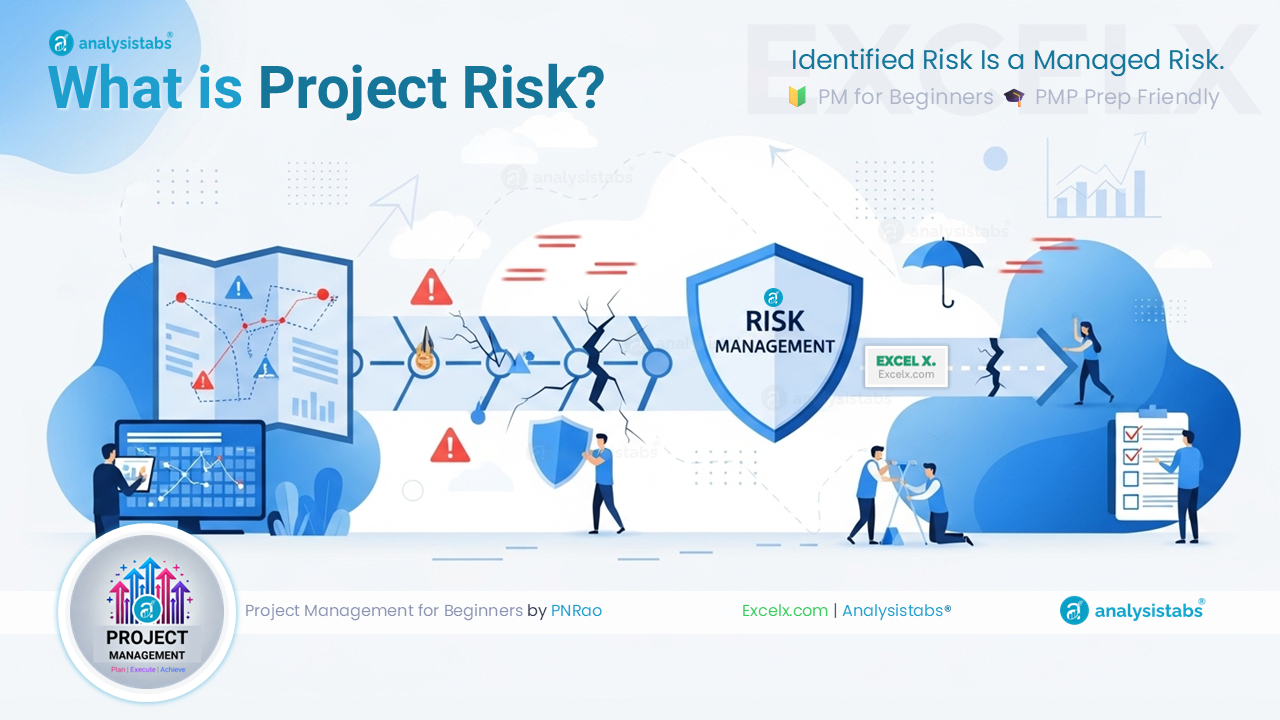
Project risk is any uncertain event or condition that, if it occurs, could have a positive or negative effect on one or more of your project’s objectives — including scope, schedule, cost, and quality. Every project carries risk from the moment it is authorized. Whether risk exists is never the question; it always does. The only meaningful question is whether your team has identified it, assessed it, and put a response plan in place before it materializes into an issue that derails delivery.
In this post, we cover the official definition of project risk, the distinction between threats and opportunities, the seven most common risk categories, how to build a working risk register, the four response strategies every PM must know, and a practical framework for managing risk through every phase of the project.
What Is Project Risk?
Project risk is formally defined by PMI as an uncertain event or condition that, if it occurs, has a positive or negative effect on project objectives. That definition contains two words that most practitioners overlook: “uncertain” and “positive.” Risk is not a problem — it is an uncertainty. And not all project risks are threats. Some are opportunities that, if captured, could accelerate the schedule, reduce costs, or improve the final product.
“An uncertain event or condition that, if it occurs, has a positive or negative effect on one or more project objectives such as scope, schedule, cost, and quality.”
— A Guide to the Project Management Body of Knowledge (PMBOK® Guide), Project Management Institute (PMI)
🧑💼 PNRao’s Plain English VersionProject risk is anything that might happen — and hasn’t yet — that could change your project’s outcome for better or worse. If it has already happened, it is no longer a risk; it is an issue that needs an immediate response. The job of risk management is to find these uncertainties early, decide which ones are worth worrying about, and build a plan for handling them before they become problems you are scrambling to fix at 11 PM the week before go-live.
Risk vs. Issue — A Critical Distinction
One of the most common and costly confusions in project management is treating risks and issues as interchangeable. They are not — and managing them incorrectly leads to the wrong response at the wrong time.
🎓 PMP Exam TipThe PMP exam consistently tests the distinction between risks and issues. Remember: a risk has not happened yet; an issue has. The exam also tests the positive risk concept — many candidates assume all project risks are negative threats. In reality, PMI defines risk as including opportunities. A common exam question presents a scenario where an external change could benefit the project and asks what type of risk response is appropriate — the correct answer involves exploiting or enhancing the opportunity, not avoiding or mitigating it.
7 Categories of Project Risk Every PM Must Know
Project risk does not arrive in a single form. Understanding the categories helps project managers build more complete risk registers, because each category requires a different identification approach and a different type of response plan. The seven categories below cover the vast majority of project risks encountered across industries and project types.
Scope Risk — The Boundaries Shift
Scope risk is the probability that what the project is supposed to deliver will change, expand, or become unclear during execution. Poorly defined requirements, vague acceptance criteria, and absent change control processes are the primary drivers. Consequently, scope risk is most effectively managed by investing in a rigorous scope definition process at the start of the project — including explicit exclusions — rather than relying on change control alone to contain scope growth after it begins. See our guide on project scope for a step-by-step approach to scope definition.
Schedule Risk — The Timeline Slips
Schedule risk is the probability that tasks will take longer than estimated, that dependencies will be delayed, or that the critical path will extend beyond the planned project end date. Optimistic estimating, unidentified dependencies, and resource conflicts are the most common causes. Additionally, schedule risk compounds over time — a small slip in Week 3 that is not recovered typically becomes a large slip by Week 10.
Cost Risk — The Budget Is Exceeded
Cost risk is the probability that the project will spend more than its approved budget. It is driven by inaccurate cost estimates, unplanned scope additions, resource rate changes, and inflation on long-duration projects. Moreover, cost risk is often a downstream consequence of scope and schedule risk — when scope expands or the timeline slips without a corresponding budget increase, the cost baseline is breached by default.
Resource Risk — The Right People Are Not Available
Resource risk covers the probability that the people, equipment, or materials required to complete the project will not be available when needed. Key person dependency — where a single team member holds critical knowledge or skills — is one of the most common and most underestimated forms of resource risk. Despite its frequency, it rarely appears on risk registers until a key person has already left, at which point it has become an issue rather than a risk.
Technical Risk — The Solution Does Not Work as Expected
Technical risk is the probability that the chosen technology, architecture, or approach will fail to perform as required. It is most prevalent on projects involving new technology, complex system integrations, or unproven methodologies. Proof-of-concept work, technical spikes, and early prototyping are the most effective mitigations — because discovering a fundamental technical limitation in Week 12 is far more expensive than discovering it in Week 2.
External Risk — Forces Outside the Team’s Control
External project risks include regulatory changes, vendor failures, market shifts, weather events, and political or economic instability. Because external risks are outside the project team’s direct control, they carry a higher uncertainty than internal risks and often require contingency reserves rather than active mitigation plans. Specifically, external risks tied to regulatory deadlines or third-party dependencies should be tracked closely and escalated to the sponsor the moment an early warning signal appears.
Stakeholder Risk — Support Erodes or Expectations Diverge
Stakeholder risk is the probability that key stakeholders will withdraw their support, change their requirements mid-project, or fail to provide timely decisions and approvals. It is one of the most underlogged categories on most risk registers — partly because PMs are reluctant to document stakeholder-related risks formally, and partly because the symptoms (slow approvals, vague feedback, shifting priorities) are easy to rationalize as normal project behavior rather than as risk signals requiring a response plan.
What Is a Risk Register and How to Build One
The risk register is the primary tool for documenting and tracking project risk throughout the delivery lifecycle. It is a living document — not a one-time planning artifact — that should be reviewed and updated at every project status meeting from initiation through closure.
The Six Fields Every Risk Register Entry Needs
| Field | What to Record | Example |
|---|---|---|
| Risk ID | A unique reference number for tracking | R-007 |
| Risk Description | A clear cause-risk-effect statement: “Due to [cause], [risk event] may occur, resulting in [effect]” | “Due to reliance on a single senior developer, if that developer leaves before go-live, the integration module may be incomplete, resulting in a 6-week schedule delay” |
| Probability | Likelihood of occurrence — rated Low / Medium / High or 1–5 scale | Medium (3/5) |
| Impact | Severity if it occurs — rated Low / Medium / High or 1–5 scale | High (5/5) |
| Risk Score | Probability × Impact — determines prioritization | 15 / 25 — HIGH priority |
| Response Plan | The chosen strategy (avoid / transfer / mitigate / accept) with specific actions and a named owner | Mitigate — cross-train a second developer on the integration module by Week 4. Owner: Tech Lead |
💡 Write Risks as Cause-Risk-Effect StatementsThe most common risk register mistake is writing vague one-line risk descriptions like “integration may fail” or “budget might overrun.” These are too imprecise to generate a useful response plan. Instead, always use the cause-risk-effect format: “Due to [root cause], [uncertain event] may occur, resulting in [specific impact on project objectives].” This forces the team to think through the mechanism of the risk — which almost always reveals a better mitigation than a vague description ever could.
🎓 PMP Exam TipThe PMP exam tests risk register content extensively. Know that the risk register must include: risk description, probability, impact, risk score (P × I), risk owner, and response plan. The exam also tests the concept of residual risk (the risk that remains after a response has been implemented) and secondary risk (new risk created by implementing a response). Both must be documented in the risk register when they exist.
The 4 Risk Response Strategies for Negative Risk (Threats)
Once a project risk has been identified, assessed, and prioritized, the PM must select a response strategy. PMI defines four strategies for negative risks (threats) and three for positive risks (opportunities). Every risk on the register must have an assigned strategy — “we’ll deal with it if it happens” is not a risk response plan; it is an issue response plan written in advance.
Avoid — Eliminate the Uncertainty Entirely
Avoidance changes the project plan to eliminate the risk or protect project objectives from its impact. This might mean choosing a different technology, changing the project approach, extending the schedule, or reducing scope. Avoidance is the strongest response — it makes the risk impossible to occur. However, it is not always practical or cost-effective. Therefore, avoidance is most appropriate for high-probability, high-impact risks where the cost of avoidance is lower than the expected cost of the risk materializing.
Transfer — Shift the Financial Consequence to a Third Party
Risk transfer moves the financial impact of a risk to another party — typically through insurance, performance bonds, fixed-price contracts, or warranty agreements. Critically, transfer does not eliminate the risk — the uncertain event can still occur. What changes is who bears the financial consequence if it does. Consequently, transfer is most appropriate for risks that are financial in nature and where a third party is better positioned to absorb or manage the cost.
Mitigate — Reduce Probability, Impact, or Both
Mitigation takes action before the risk occurs to reduce either its likelihood of happening or the severity of its impact if it does. Examples include cross-training team members to reduce key person dependency risk, conducting proof-of-concept work to reduce technical risk, or building schedule contingency to reduce the impact of task overruns. Mitigation is the most commonly used risk response strategy in practice — it is proportionate, practical, and directly actionable by the project team without requiring external parties or major plan changes.
Accept — Acknowledge the Risk and Prepare a Contingency
Acceptance acknowledges that a risk exists but makes a deliberate decision not to take proactive action — either because the cost of response outweighs the expected impact, or because no effective response is available. Two forms of acceptance exist: passive (no action, monitor only) or active (establish a contingency reserve or a contingency plan to execute if the risk occurs). Active acceptance is always preferable to passive acceptance for anything above low-priority risk levels, because it ensures the team has a defined response ready rather than improvising under pressure.
Response Strategies for Positive Risk (Opportunities)
PMI also defines three strategies for positive risks — uncertain events that could benefit the project if they occur:
Project Risk Examples Across Five Industries
Project risk manifests differently in every industry, but the identification and response framework remains the same. The examples below show how the risk register categories and response strategies apply in real project environments — and what happens when they are not applied.
| Industry | Risk Category | Real-World Risk Example | Response Strategy Used |
|---|---|---|---|
| 💻 IT / Software | Technical Risk | Third-party API selected for payment processing has undocumented rate limits that could fail under peak load — discovered during integration testing in Week 8 | Mitigate — load testing conducted in Week 3; fallback payment processor identified and contracted as contingency |
| 🏗️ Construction | External Risk | Specialist steel supplier has a 14-week lead time that conflicts with the foundation completion date — identified during procurement planning | Avoid — redesigned the build sequence to allow foundation work and steel fabrication to run in parallel; order placed 6 weeks earlier |
| 🏦 Banking | External / Regulatory Risk | Regulatory body announced a change to reporting format requirements mid-project that could require rework of 3 completed modules | Transfer — contract clause with the software vendor required them to absorb rework costs for regulatory changes during the implementation period |
| 🏥 Healthcare | Stakeholder Risk | Clinical staff resistance to new electronic health record system identified through early stakeholder interviews — risk of low adoption at go-live | Mitigate — clinical champions program launched in Week 4; on-ward training sessions added to the project plan; go-live support team doubled |
| 🏪 Retail | Resource Risk | Single warehouse integration developer holds all institutional knowledge of the legacy system — no documentation and no backup resource identified | Mitigate — knowledge transfer sessions scheduled for Weeks 2–4; legacy system documentation completed before development sprint began |
PNRao’s Field TakeIn my experience, the risks that derail projects are almost never the ones on the risk register — they are the ones that never made it onto the register because someone felt uncomfortable raising them, or because the team assumed someone else was tracking them. The most common category I see missing from risk registers is stakeholder risk — specifically, the risk that a key sponsor will lose interest, change priorities, or be reassigned before the project ends. If your risk register does not have at least one stakeholder-related risk on it, it is incomplete. Log it, name the sponsor, and build a communication plan around it — even if it feels politically sensitive to write down.
How to Manage Project Risk — A Practical Framework
Effective project risk management is a continuous process — not a single planning session followed by a risk register that nobody reads again. According to Atlassian’s risk management guide, teams that conduct structured risk reviews throughout delivery are significantly more likely to avoid last-minute project crises than teams that treat risk identification as a one-time planning exercise. The framework below reflects how risk management actually works on projects that handle it well, across all project sizes and industries.
Step 1 — Identify Risks Early and Continuously
Risk identification should begin during the initiation phase and continue throughout delivery. Use structured techniques: brainstorming sessions with the full project team, checklists from previous similar projects, interviews with subject matter experts, and assumption analysis. Furthermore, every new team member, every new vendor, and every scope change is a potential source of new risk that should trigger a risk review. Use our free Project Plan Template to build your initial risk log alongside your scope and schedule during the planning phase.
Step 2 — Assess Each Risk Using Probability and Impact
Once identified, each risk must be assessed on two dimensions: how likely is it to occur (probability), and how severe would the impact be if it did (impact on scope, schedule, cost, or quality). Plot each risk on a probability-impact matrix to determine its overall risk score and priority level. High-probability, high-impact risks demand immediate response plans. Low-probability, low-impact risks can be accepted and monitored. Additionally, risks that are high impact but low probability still warrant contingency planning — because although they are unlikely, their consequences if they occur could be project-ending.
Step 3 — Assign a Response Strategy and a Named Owner
Every risk above the acceptance threshold must have an assigned response strategy — avoid, transfer, mitigate, or accept — with specific actions defined and a named risk owner responsible for executing and monitoring the response. A risk without an owner is a risk without accountability, which is functionally the same as having no response plan at all. Therefore, ownership must be assigned at the time the risk is logged, not deferred until the risk becomes more serious.
Step 4 — Review the Risk Register at Every Status Meeting
The risk register must be a standing agenda item at every project status meeting — not a document that is opened once during planning and revisited only when something goes wrong. Specifically, each project risk review should ask: Has any risk’s probability or impact changed? Have any risks become issues? Are any new risks emerging from current project activities? Have any risks passed their trigger date without occurring and can now be closed? This discipline keeps the register current and ensures the team is managing forward rather than reacting backward.
On an enterprise CRM implementation for a US-based insurance company, the project team conducted a thorough risk identification workshop in Week 1 and logged 22 risks across all seven categories. One risk — flagged as Medium probability, High impact — was that the legacy policy management system had undocumented data structures that would complicate the data migration. A data audit was scheduled for Weeks 3 and 4 before migration design began, with the data architect named as risk owner. That audit completed on schedule and revealed 14 undocumented field types that would have caused migration failures. Consequently, the team redesigned the migration scripts in Week 5, and the migration phase completed without a single data integrity incident.
However, on the same project, a stakeholder risk that had been raised verbally in a team meeting — specifically, that the VP of Sales was skeptical of the new system and had the influence to block adoption — was never formally logged. By Week 14, the VP had instructed his regional managers not to use the new system until “further review.” User adoption at go-live was 31%, against a target of 85%. As a result, the project was technically delivered on time and on budget but failed to deliver its business case. Logging the stakeholder risk, assigning a response plan, and involving the VP in key decisions from Week 2 onward would almost certainly have produced a different outcome.
🎯 Key Takeaways — The 90-Second Summary
Share This Story, Choose Your Platform!
80+ PREMIUM
Budget, Finance,
Calendars & Life
Planner Templates
→ Get Premium Templates
Take Control of Your Finances
Interactive dashboards, auto-calculations & visual breakdowns — starting from just $9.