
What You’ll Learn in This Post
- The precise definition of the iron triangle in project management — official and plain English
- Why it’s called the iron triangle — and what “iron” actually means for your project
- How scope, time, and cost interact — and what happens when you change any one of them
- The role of quality inside the triangle — and why it’s different from the three constraints
- Real-world iron triangle examples across IT, construction, retail, healthcare, and banking
- A practical trade-off framework for managing constraint conflicts before they become project crises
The iron triangle in project management is the foundational model that explains why every project faces the same unavoidable tension: you can control scope, time, and cost — but you cannot change one without affecting the others. Every project constraint decision you make as a project manager flows from this single principle. Understanding it deeply is not optional — it is the starting point for every trade-off conversation, every stakeholder negotiation, and every recovery plan you will ever run.
In this post, we cover the origin and official definition of the iron triangle, how each of its three sides works in practice, where quality fits in, and how to use the model as a practical decision-making tool — not just a concept you mention in a kickoff deck.
What Is the Iron Triangle in Project Management?
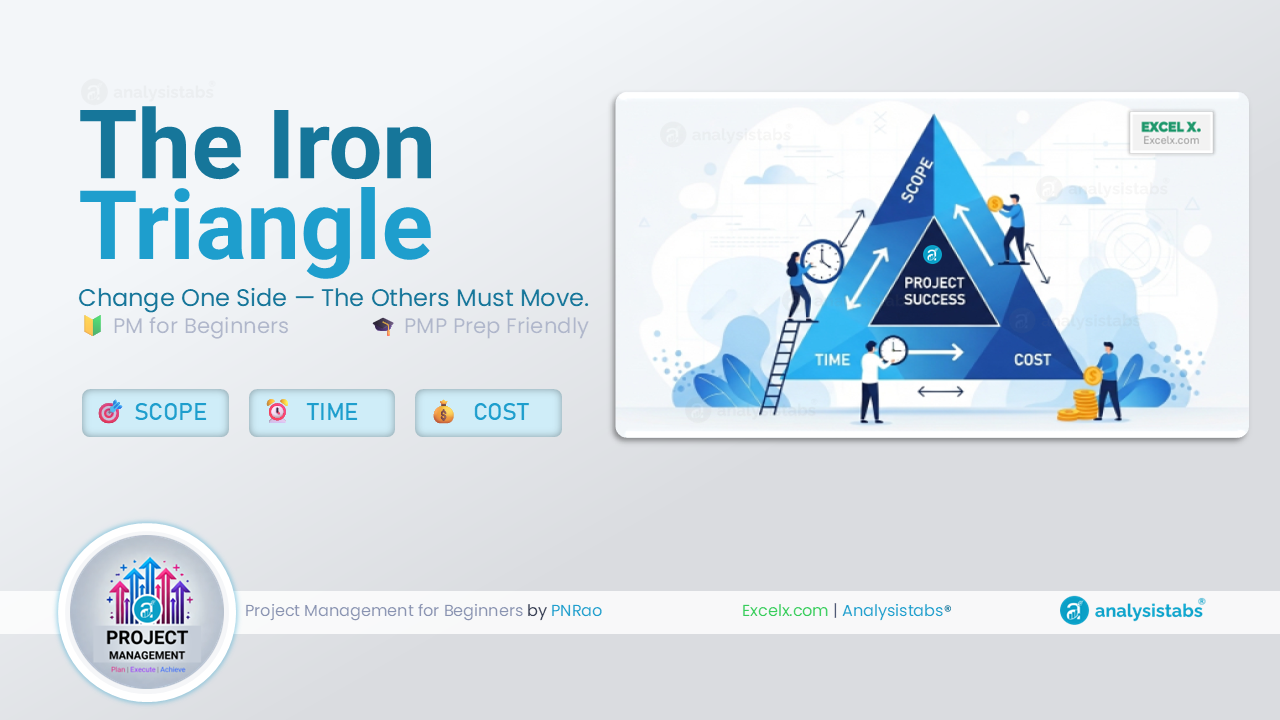
The iron triangle — also widely known as the triple constraint or the project management triangle — is a model that defines the three core constraints governing every project: scope (what you deliver), time (when you deliver it), and cost (what it takes to deliver it). These three constraints are interdependent. Adjust any one of them and the others are inevitably affected — which is precisely what makes them a triangle rather than three independent variables.
“Every project is constrained in different ways by its scope, time, and cost goals. These constraints are sometimes called the triple constraint.”
— A Guide to the Project Management Body of Knowledge (PMBOK® Guide), Project Management Institute (PMI)
Why Is It Called the “Iron” Triangle?
The word “iron” is deliberate and important. It signals that these constraints are rigid — they cannot be wished away, ignored, or negotiated out of existence by a forceful sponsor or an optimistic schedule. Unlike preferences or priorities, which can shift during a project, the relationship between scope, time, and cost is structural. Consequently, understanding the iron triangle in project management is fundamentally about accepting the physical and financial limits of project delivery — and working within them rather than pretending they do not apply. Moreover, the rigidity of the model is what makes it useful: a triangle you could stretch in any direction would offer no predictive power at all.
The Three Sides of the Iron Triangle — Explained
Each side of the iron triangle represents a constraint that the project manager must define, baseline, and actively manage throughout the project lifecycle. Together, they form the boundary within which all project decisions must operate.
Scope — What You Deliver
Scope defines the totality of work the project must produce: every deliverable, every feature, every function, and every piece of work required to produce them. A well-defined project scope sets the boundary of what is included and — critically — what is excluded. In the context of the iron triangle, scope is the constraint that most commonly expands without a corresponding increase in time or cost. That uncontrolled expansion is scope creep — one of the leading causes of project failure. Consequently, scope must be formally baselined and protected through a change control process from the moment the project is authorized.
Time — When You Deliver It
Time refers to the project schedule — the total duration from start to finish, including every milestone, dependency, and deadline along the way. In the iron triangle, time is often the constraint with the least flexibility — particularly on projects with regulatory deadlines, contractual go-live dates, or market launch windows. However, schedule compression is possible through crashing (adding resources) or fast tracking (overlapping tasks), both of which carry cost and risk implications. Therefore, any request to shorten the timeline must trigger an immediate assessment of the scope and cost impact.
Cost — What It Takes to Deliver It
Cost encompasses the total financial resources required to complete the project: labor, materials, equipment, licenses, third-party services, and overhead. In the iron triangle, cost is constrained by the approved project budget — which itself is derived from the scope and schedule at the time of authorization. Reducing cost without reducing scope or extending the timeline typically means reducing resource quality or quantity, which in turn creates delivery risk. As a result, budget cuts made in isolation — without a corresponding scope reduction — are one of the most reliable predictors of project failure.
Where Does Quality Fit in the Iron Triangle?
Quality is often depicted at the center of the iron triangle in project management — not as a fourth constraint alongside scope, time, and cost, but as the output that results from how well those three constraints are balanced. This distinction matters enormously in practice.
Understanding quality as the result — not the input — changes how you defend it in difficult conversations. When a sponsor asks you to cut the schedule without changing scope or budget, the correct response is not “that will reduce quality” as an abstract warning. Instead, it is a specific statement: “Cutting four weeks means we eliminate system integration testing, which means defects we would have caught in testing will go live in production.” Furthermore, that specificity is what changes the conversation from a subjective debate about quality standards into a concrete risk discussion that stakeholders can actually act on.
How the Iron Triangle Constraints Interact — The Six Trade-Offs
Every change request in the context of the iron triangle in project management ultimately reduces to one of six possible constraint interactions. Recognizing which trade-off you are being asked to make — and communicating it explicitly — is one of the most practical skills a project manager can develop.
| Stakeholder Request | Constraint Changed | Required Adjustment | Risk If Ignored |
|---|---|---|---|
| Add more features | Scope increases ↑ | Extend timeline OR increase budget OR remove other scope | Schedule overrun, budget overrun, or both |
| Deliver two weeks earlier | Time decreases ↓ | Reduce scope OR increase budget (add resources) OR accept quality risk | Rushed delivery, defects, burned-out team |
| Cut the budget by 20% | Cost decreases ↓ | Reduce scope OR extend timeline OR reduce resource quality | Under-delivery, team under-resourcing, hidden technical debt |
| Add features AND deliver earlier | Scope ↑ + Time ↓ | Significant budget increase required — or this is not possible | Extremely high failure risk if budget is not adjusted |
| Cut budget AND deliver earlier | Cost ↓ + Time ↓ | Scope must be significantly reduced to make this viable | Project delivers fraction of original value |
| More features, less time, less cost | All three constrained simultaneously | This request is not manageable — must be challenged immediately | Guaranteed delivery failure or severe quality degradation |
Iron Triangle Examples Across Five Industries
The iron triangle in project management applies to every project in every industry — the constraints change in scale and form, but the underlying trade-off logic is identical. The following examples show how the three constraints manifest in practice and what happens when one is changed without adjusting the others.
| Industry | Project Type | Iron Triangle in Action | Constraint That Was Fixed |
|---|---|---|---|
| 💻 IT / Software | ERP system implementation | Go-live date fixed by regulatory deadline. Scope reduced in phases 2 and 3 to meet the date. Budget held. Result: Phase 1 delivered on time with reduced features; subsequent phases delivered post-go-live. | Time (regulatory deadline — non-negotiable) |
| 🏗️ Construction | Commercial office fit-out | Client added two additional floors of fit-out scope mid-project. Timeline extended by 8 weeks and budget increased by $340,000. Contractor formally documented the change before proceeding. | Scope increased → Time and Cost adjusted accordingly |
| 🏦 Banking | Core banking platform migration | CFO demanded a 15% budget cut in Week 6. PM demonstrated via scope analysis that the cut required removing the automated reconciliation module. CFO approved the scope reduction after reviewing the downstream operational cost of manual reconciliation. | Cost decreased → Scope formally reduced to compensate |
| 🏥 Healthcare | Electronic health record rollout | Hospital board requested go-live moved forward by 6 weeks to align with a new fiscal year. PM’s analysis showed this required adding two implementation teams at $180,000 additional cost. Board approved the budget increase. | Time compressed → Cost increased to maintain scope |
| 🏪 Retail | E-commerce platform relaunch | Marketing locked in a Black Friday launch date that could not move. When development estimates came in 3 weeks over schedule, the team cut the loyalty points feature and the gift card module to protect the date and budget. Both were delivered in a January release. | Time fixed (Black Friday) → Scope reduced to fit |
Notice that in every example above, the iron triangle was respected — not broken. The constraint that was fixed was identified explicitly, and the other two were adjusted accordingly through a formal decision, not a quiet workaround. Consequently, each project team avoided the most common failure mode: absorbing constraint pressure silently until it surfaces as a crisis in the final weeks of delivery. That is exactly how the model is supposed to work in practice.
How to Manage the Iron Triangle on Your Projects
Knowing the iron triangle in project management as a model is one thing. Using it actively as a management tool throughout the project lifecycle is what separates project managers who control their projects from those who react to them. The framework below reflects how experienced PMs apply the model from planning through execution.
Step 1 — Establish the Priority Constraint at Project Start
Before planning begins, ask the sponsor one question: “If we reach a point where we cannot meet all three constraints simultaneously, which one is the priority?” In most projects, one constraint is fixed and the other two are flexible. A regulatory deadline makes time fixed. A non-negotiable budget cap makes cost fixed. A contractually defined deliverable set makes scope fixed. Documenting the priority constraint in the project charter gives the PM a pre-approved decision rule for every trade-off conversation that follows — and eliminates the need to escalate every minor conflict.
Step 2 — Baseline All Three Constraints Formally
The iron triangle only functions as a management tool when all three sides are formally baselined. A vague scope statement, an uncosted schedule, or a verbal budget agreement gives the PM nothing to measure against when change requests arrive. Consequently, the planning phase must produce three documented baselines — a scope baseline, a schedule baseline, and a cost baseline — that serve as the reference points for all subsequent change control decisions. Use our free Project Plan Template to capture and baseline all three constraints in a single document from day one.
Step 3 — Run Every Change Request Through the Triangle
When a change request arrives — whether formal or informal — evaluate it explicitly against all three constraints before responding. How does this request affect scope? How does it affect the schedule? How does it affect the budget? Document the impact on all three, present the options to the decision-maker, and get a signed decision before proceeding. This discipline prevents the silent accumulation of unmanaged changes that eventually surfaces as a project crisis. Moreover, it creates a paper trail that protects the PM when scope, schedule, or budget questions arise later in the project.
Step 4 — Communicate Constraint Status at Every Steering Meeting
At every steering committee or sponsor update, report the current status of all three constraints — not just the schedule. A RAG (Red/Amber/Green) status for scope, time, and cost gives stakeholders a complete picture of project health and surfaces constraint tensions before they become irreversible. Furthermore, it reinforces to sponsors that the iron triangle is a live management framework, not a one-time planning artifact.
On a major e-commerce platform relaunch for a mid-size US retailer, the VP of Marketing confirmed a Black Friday launch date in Week 2 of the project — which became the fixed time constraint for the entire delivery. By Week 9, the development team reported that the full feature set would require 14 more weeks, putting the launch date 6 weeks at risk. The initial pressure from the business was to “just find a way” — keeping scope, time, and cost all unchanged.
Instead, the project manager ran a formal scope prioritization session using the MoSCoW method, identifying which features were essential for launch day versus which could follow in a January release. As a result, the loyalty points engine and the gift card module — two features that accounted for roughly 30% of remaining development effort — were formally deferred. The platform launched on Black Friday with its core shopping, checkout, and personalization features intact. The January release delivered the deferred features on schedule. Total additional cost: $0. The key was making the trade-off explicit and formal rather than absorbing it quietly into an already-stressed team.
The Iron Triangle in Agile Projects
One of the most important evolutions in project management thinking over the past two decades is how agile frameworks reframe the iron triangle in project management. In traditional (waterfall) project management, all three constraints are typically fixed at the start and scope is the variable that absorbs change. Agile inverts this model — time and cost are fixed (the sprint cadence and team capacity are stable), and scope is the variable that flexes to fit within each iteration. Consequently, agile teams make constraint trade-offs continuously rather than catastrophically.
According to the PMI Pulse of the Profession, organizations using agile or hybrid delivery approaches report significantly higher rates of on-time, on-budget delivery than those using purely waterfall methods — in part because the agile iron triangle makes the scope trade-off continuous and explicit rather than catastrophic and late.
🎯 Key Takeaways — The 90-Second Summary
Share This Story, Choose Your Platform!
80+ PREMIUM
Budget, Finance,
Calendars & Life
Planner Templates
→ Get Premium Templates
Take Control of Your Finances
Interactive dashboards, auto-calculations & visual breakdowns — starting from just $9.